
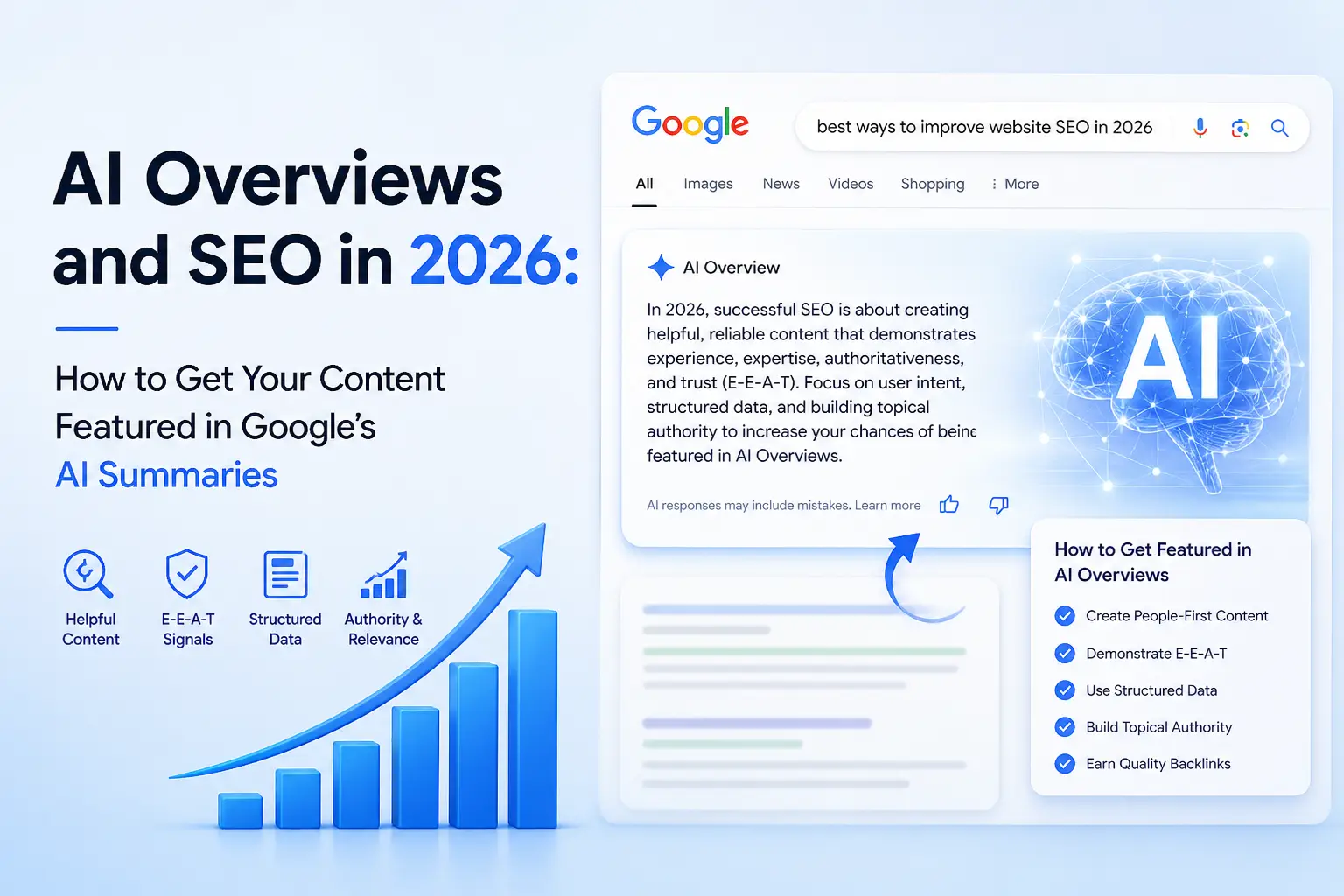
Google’s AI Overviews the AI-generated summaries that now appear at the top of search results for millions of queries have fundamentally changed the SEO landscape. For businesses that appear in AI Overviews, visibility and credibility increase dramatically. For those that don’t, traditional organic rankings deliver less click-through than ever.
In 2026, optimizing for AI Overviews is no longer optional for SEO-conscious businesses. It’s a core pillar of any modern search strategy. This guide breaks down exactly how AI Overviews work, what signals Google uses to select cited sources, and the specific content and technical optimizations that increase your probability of being featured.
This is central to what Techlooker’s SEO services agency delivers for clients search optimization that performs not just in traditional blue links, but in AI-generated answers, conversational queries, and the next generation of search discovery.
What Are Google AI Overviews and Why They Matter for SEO
Google AI Overviews (formerly Search Generative Experience) are AI-generated responses that appear above traditional organic search results for informational, research, and how-to queries. They synthesize information from multiple web sources and provide a direct answer often citing 3-8 source websites with attribution links.
The SEO implications are profound. Pages cited in AI Overviews receive high-visibility placement without necessarily ranking in the traditional top-3 organic positions. Conversely, pages that traditionally ranked #1-3 but aren’t cited in AI Overviews see reduced click-through rates as users consume the answer directly in the Overview.
Early data from 2025-2026 shows AI Overviews appearing on approximately 14% of all Google searches globally with significantly higher rates for informational queries (30-40%) and lower rates for navigational and transactional queries (5-10%).
For businesses in industries with high informational search volume healthcare, financial services, legal, technology AI Overview optimization is now a critical traffic driver.
What Signals Does Google Use to Select AI Overview Sources?
Google has not published an official AI Overview selection algorithm. However, analysis across thousands of queries and source citations has identified consistent patterns in what gets cited:
E-E-A-T (Experience, Expertise, Authoritativeness, Trustworthiness)
Google’s quality rater guidelines emphasize E-E-A-T as the foundational quality signal. Pages with demonstrated expertise (author credentials, industry recognition), authoritative domain signals (quality backlinks, industry citations).
And trustworthiness signals (accurate information, clear authorship, transparent sourcing) consistently outperform thin content in AI Overview citations.
Our SEO consulting services team helps clients build E-E-A-T signals systematically through content strategy, author profile development, and authority building programs.
Content Structure and Semantic Clarity
AI systems parse structured content more easily than dense prose. Pages with clear question-and-answer structure, defined sections with descriptive headings.
FAQ schema markup, and direct answers to specific questions are significantly more likely to be cited in AI Overviews.
Comprehensiveness and Topic Coverage
AI Overviews favor comprehensive, authoritative coverage of a topic over narrow, keyword-optimized pages. A 3,000-word definitive guide to a topic that addresses multiple angles, answers related questions, and provides concrete examples consistently outperforms a 500-word page targeting a single keyword.
Source Credibility and Backlink Authority
Domain authority, quality of referring domains, and the topical relevance of inbound links all contribute to AI Overview citation likelihood. Google’s AI systems effectively trust the same domain quality signals that inform traditional organic rankings just applied in a new context.
Technical SEO Optimizations for AI Overview Visibility
Getting technically optimized for AI Overviews requires attention to several specific implementation areas:
Structured Data and Schema Markup
FAQ schema, HowTo schema, Article schema with author details, and Speakable schema all provide machine-readable signals that help Google understand your content structure. Pages with relevant schema markup are consistently more likely to be cited in AI Overviews for matching query types.
Clear Information Architecture
AI systems parse pages by structure. H1 titles should match user question intent directly. H2 and H3 headings should be descriptive and question-based where appropriate. Each section should answer a specific sub-question. This makes it easy for Google’s AI to extract precise answer segments.
Page Speed and Core Web Vitals
Google must be able to crawl and render your pages efficiently to include them in AI knowledge sources. Poor page speed, JavaScript rendering issues, and Core Web Vitals failures all reduce crawl priority and can deprioritize your content from AI training and citation pools.
Technical SEO foundations directly impact AI Overview eligibility. Our AI SEO services team performs comprehensive technical audits and implements the structural optimizations needed to maximize AI citation probability.
Content Strategy for AI Overview Optimization
The content strategy required to earn AI Overview citations requires a shift from traditional keyword-targeting to intent-mapping and answer-engineering.
Map Your Content to Specific Questions, Not Just Keywords
AI Overviews are triggered by questions and informational intent. Instead of optimizing for “CRM software,” optimize for “how does CRM software improve sales team productivity?
” Or “what is CRM software used for in small businesses?” Every piece of content should be built around a specific user question with a clear, direct answer in the first paragraph.
Cover Topic Clusters, Not Individual Keywords
Google’s AI favors comprehensive sources. A website with 50 interconnected articles covering every aspect of a topic from multiple angles looks more authoritative than a single page targeting one keyword.
Topic cluster architecture with a pillar page covering the main topic and cluster pages covering related subtopics is the single most effective content structure for AI Overview optimization.
Internal linking between topic cluster pages is also critical. Our SEO services agency builds internal linking strategies that strengthen topical authority and maximize the crawl and citation value of every page in a cluster.
Measuring AI Overview Performance
Traditional SEO metrics (rankings, organic clicks) don’t fully capture AI Overview impact. Brands cited in AI Overviews often see increased brand search volume, direct traffic, and referral clicks from Overview citations even when traditional ranking positions don’t change.
Track these metrics to measure AI Overview optimization progress. AI Overview citation rate (Search Console impression data + manual query testing), branded search volume trends, organic CTR.
Changes for informational queries, and assisted conversion attribution from AI Overview referral traffic.
As Google’s AI-powered search continues to evolve, staying ahead of AI Overview optimization requires ongoing strategy, not one-time implementation. Contact Techlooker’s SEO team to discuss how we build AI Overview visibility into your content strategy.