
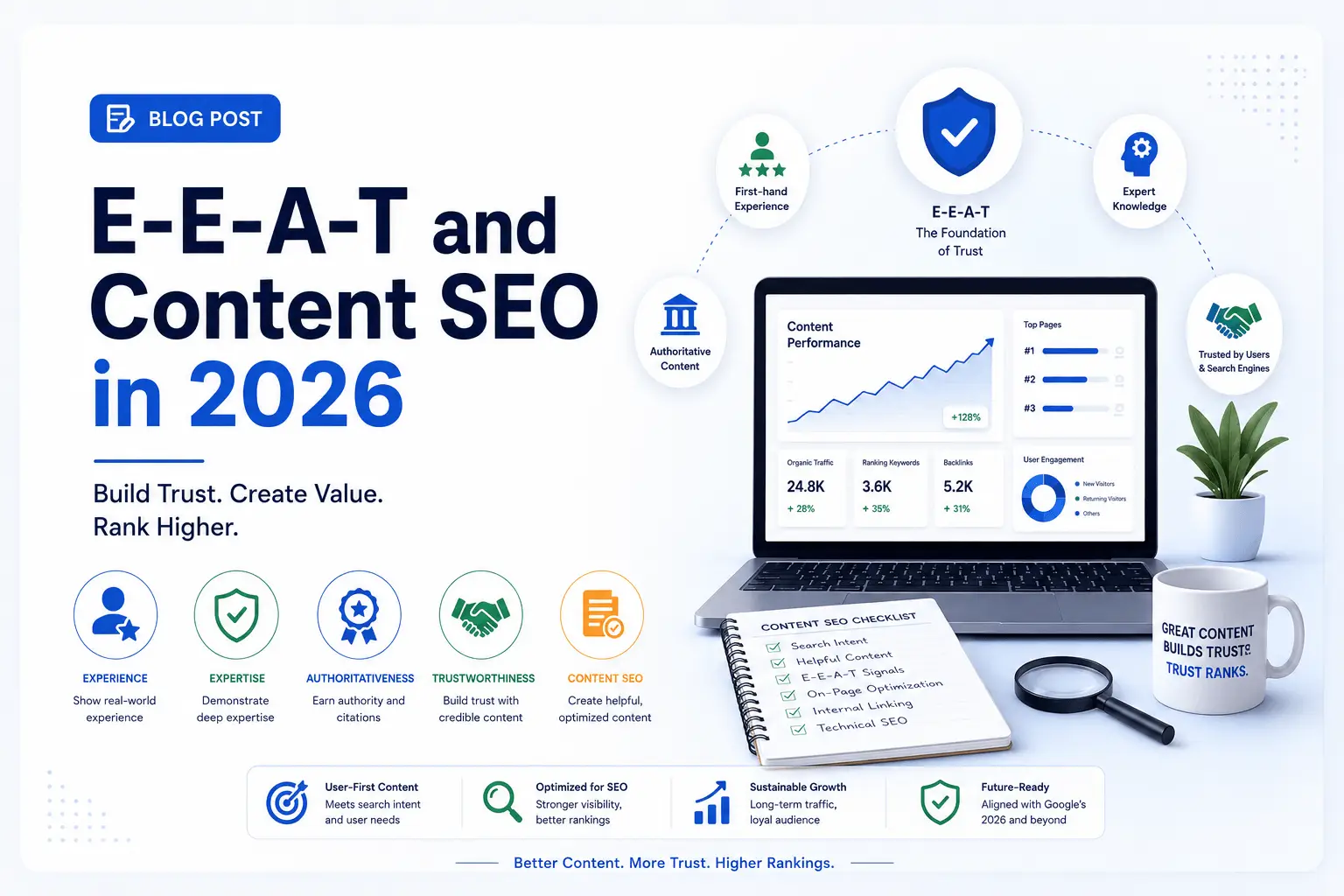
Google’s content quality framework E-E-A-T (Experience, Expertise, Authoritativeness, Trustworthiness) has become the most important concept in content SEO over the past three years. As AI-generated content floods the internet, Google’s quality signals have sharpened to distinguish genuinely authoritative content from algorithmically produced information that lacks real human expertise.
For businesses investing in content SEO in 2026, understanding and building E-E-A-T is the difference between content that ranks, earns citations in AI Overviews, and drives conversions and content that gets filtered, filtered again, and eventually ignored by both search engines and readers.
This guide covers what E-E-A-T means in practice, how to build each signal systematically, and how Techlooker’s SEO services agency integrates E-E-A-T principles into every content SEO program.
What Is E-E-A-T and Why It Matters in 2026
E-E-A-T stands for Experience, Expertise, Authoritativeness, and Trustworthiness. These are the quality dimensions Google’s human quality raters assess when evaluating search results and the signals Google’s algorithm attempts to quantify algorithmically.
- Experience: Does the author have first-hand, real-world experience with the topic? (Added to EAT in December 2022 a direct response to AI-generated content that lacks genuine experience)
- Expertise: Does the author have formal or demonstrated expertise in the subject matter? (Especially critical for YMYL Your Money or Your Life topics like health, finance, and legal content)
- Authoritativeness: Is the website and author recognized as an authority by others in their field? (Links, citations, mentions from credible sources)
- Trustworthiness: Can users trust the information on the page and the website overall? (Accuracy, transparency, security, clear authorship)
In 2026, E-E-A-T’s importance has intensified for two reasons: the proliferation of AI-generated content (which often has no Experience signal whatsoever) has made authentic first-hand content more valuable, and AI-powered search systems (Google’s AI Overviews, ChatGPT search, Perplexity) are specifically trained to prefer high-E-E-A-T sources when generating citations.
Building the Experience Signal: First-Hand Knowledge in Content
The “Experience” addition to the E-E-A-T framework was specifically designed to reward content that reflects genuine, first-hand knowledge, not just well-researched secondary information.
What Experience Signals Look Like
- Personal anecdotes and case studies from direct client work or professional practice
- Specific data and outcomes from real projects (with client permission or anonymized)
- Honest acknowledgment of limitations, caveats, and situations where approaches don’t work
- Comparison of approaches based on actual implementation experience
- Original research, surveys, and data collection unique to the author/organization
AI-generated content almost universally lacks authentic experience signals. It can describe processes accurately but cannot share what went wrong on a specific client project, what unexpected challenges arose, or what the outcome was in practice. This is the content quality dimension where human authors have an enduring competitive advantage over AI.
Building Expertise Signals: Credentials, Depth, and Precision
Expertise signals are about demonstrating that the person or organization producing content has the background, credentials, and depth of knowledge to be a trusted authority on the subject.
Author Credentials and Bios
Every piece of content should have a clearly identified author with a detailed bio that establishes relevant credentials. For technical content: relevant certifications, educational background, and years of experience. For experiential content: specific industries worked in, types of projects delivered, and measurable outcomes achieved.
Google’s guidelines specifically state that authors’ expertise should be verifiable ideally through LinkedIn profiles, professional organization memberships, published work, speaking engagements, or industry recognition. Sparse “Marketing Team” author attributions or anonymous content are explicit negative signals.
Content Depth and Precision
Expert content goes beyond surface-level summaries to provide specific, actionable detail that a non-expert couldn’t produce. In technical fields, this means: exact tool configurations, specific error cases and solutions, precise cost and timeline estimates, and nuanced comparisons that acknowledge trade-offs rather than presenting everything as equally valid.
Our SEO consulting services team develops content strategies specifically designed to showcase client expertise drawing on their team’s first-hand knowledge and building the documentation infrastructure that supports E-E-A-T signals across their entire content program.
Building Authoritativeness: Earning Recognition from External Sources
Authoritativeness is largely an external signal it’s not about what you say about yourself, but about whether authoritative sources reference, cite, and link to you. This is where content SEO intersects most directly with link building and digital PR.
Earning Editorial Backlinks
Links from credible, topically relevant websites remain the strongest authoritativeness signal in Google’s algorithm. In 2026, the quality and relevance of linking sources matters far more than volume. A single editorial link from a respected industry publication is worth more than 100 links from low-quality directories.
Techlooker’s link building services focus exclusively on earning editorial-quality backlinks from relevant, authoritative sources the type of link profile that strengthens E-E-A-T rather than risking algorithmic penalties.
Industry Recognition and Brand Mentions
Being cited in industry publications, mentioned in expert roundups, invited to contribute guest articles, and featured in industry-specific directories and award lists all contribute to authoritativeness signals. These brand mentions even when unlinked are tracked by Google as entity mentions that reinforce your organization’s authority in a specific topic domain.
Building Trustworthiness: The Foundation of Content Value
Trustworthiness is the dimension that underlies all others. A highly experienced, expert, authoritative source that provides inaccurate or misleading information is not trustworthy and Google’s systems work hard to detect this.
Accuracy and Factual Correctness
Publish accurate, current information. Update articles when information changes. Cite sources for factual claims. Correct errors promptly when identified. Add “last updated” dates to evergreen content. These practices signal to both Google and readers that your content is reliable.
Transparency About Authorship, Ownership, and Intent
Clearly identify who writes content, who owns the website, and when content was last reviewed. About Us pages, author bios, and editorial policy pages all contribute to trust signals. Commercial intent (affiliate relationships, sponsored content) should be disclosed clearly hiding these relationships is an explicit trust violation per Google’s guidelines.
Security and Technical Trust Signals
HTTPS, privacy policy, terms of service, and accessible contact information are baseline trust signals. For YMYL sites, the absence of any of these is a significant negative signal that no amount of content quality can overcome.
E-E-A-T for Healthcare: YMYL Content Considerations
Healthcare content sits at the highest-stakes end of the YMYL spectrum. Google applies the most rigorous E-E-A-T standards to health content because the consequences of poor-quality health information are severe.
Techlooker’s healthcare SEO services integrate medical review processes, licensed healthcare professional authorship, and rigorous accuracy standards into every content deliverable meeting the elevated E-E-A-T bar Google applies to health content.
Measuring E-E-A-T Progress
E-E-A-T isn’t a direct ranking metric, it’s a quality assessment framework that manifests in multiple observable signals. Measure progress through:
- Organic visibility trends for informational and branded queries
- AI Overview citation rate for target queries
- Domain Authority and referring domain growth
- Brand search volume trends
- User engagement metrics (time on page, pages per session, return visitor rate)
Building content authority that earns Google’s trust and increasingly, AI systems’ citations requires a strategic, sustained program of content creation, author development, link earning, and trust signal cultivation. Contact Techlooker’s content SEO team to discuss how we build E-E-A-T into your entire content strategy.