
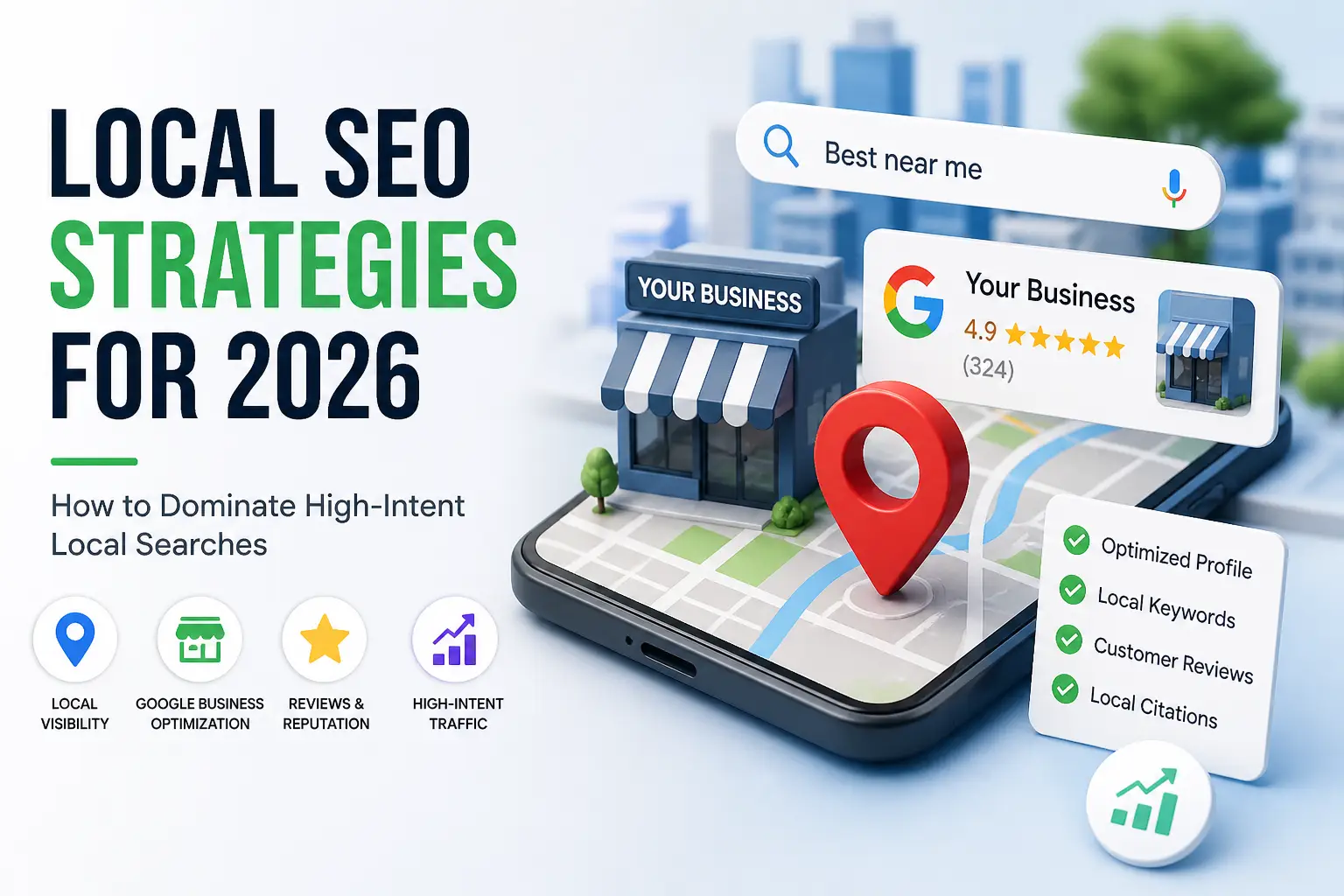
When someone searches “data analytics consulting near me” or “SEO agency in Chicago,” the businesses that appear at the top of those results aren’t there by accident. They’ve invested in a deliberate local SEO strategy that combines Google Business Profile optimization, location-specific content, citation consistency, and mobile search optimization to capture high-intent, ready-to-convert local traffic.
Local search has become even more important in 2026. Google’s local pack (the map-and-listings section at the top of local search results) now appears for a broader range of queries than ever, not just “near me” searches, but implicitly local queries for services, products, and professionals in a user’s area. Missing from the local pack means missing your highest-converting prospective customers.
Techlooker’s local SEO services help businesses across North America capture local search visibility and convert it into real-world revenue. Here’s the complete 2026 playbook.
The Local Search Landscape in 2026
Understanding the mechanics of local search is essential before diving into tactics. Local search results in 2026 typically include three distinct areas:
- Local Pack (Map Pack): The 3-listing map result that appears for local-intent queries driven primarily by Google Business Profile (GBP) signals
- Local organic results: Standard organic listings below the map pack driven by traditional SEO signals with local relevance layering
- AI Overviews with local citations: For some local queries, Google now generates AI summaries that cite local businesses and review aggregators
Ranking well in the local pack and local organic results simultaneously requires optimizing across two related but distinct signal sets. Most businesses focus exclusively on either their GBP or their website and leave significant local visibility on the table.
Google Business Profile Optimization: The Foundation of Local SEO
Google Business Profile (formerly Google My Business) is the single most important local SEO asset. An incomplete, unoptimized, or inaccurate GBP profile is the most common reason businesses fail to appear in the local pack.
GBP Optimization Essentials for 2026
- Complete every field: Business name, address, phone, website, hours, categories (primary and secondary), service areas, products/services, and attributes
- Choose the right primary category: This is the most influential ranking factor in the local pack choose the most specific category that accurately describes your primary business
- Write a keyword-rich business description: 750 characters to communicate what you do, who you serve, and what makes you different naturally incorporating your primary service keywords
- Upload high-quality photos and videos: Businesses with 100+ photos receive significantly more GBP engagement upload interior, exterior, team, and product/service imagery
- Post weekly updates: GBP Posts (offers, events, product announcements) signal active business operation and improve GBP engagement signals
- Use Q&A proactively: Seed frequently asked questions and answers in the Q&A section Google sometimes uses these in AI-generated local summaries
Review Strategy: The Local Ranking Signal You Can’t Ignore
Review signals quantity, recency, rating, and response rate are among the strongest local pack ranking factors in 2026. Businesses with significantly more recent, high-quality reviews than competitors consistently outrank them in the local pack, even when other signals are roughly equal.
Building a Review Generation Program
The most effective review generation approach is systematic: every positive customer interaction should include a structured follow-up requesting a Google review. This means post-service emails, text message follow-ups for appointment-based businesses, QR codes at points of service, and staff training to mention reviews naturally at handoff moments.
The critical compliance point: Google’s guidelines prohibit incentivized reviews (offering discounts, gifts, or other consideration in exchange for reviews). Review gating (only sending review requests to customers who’ve indicated satisfaction) is also against Google’s guidelines. The only compliant approach is asking every customer to leave an honest review.
Responding to Reviews
Responding to every review positive and negative demonstrates active engagement and signals business legitimacy to Google’s ranking algorithm. Response rate is a tracked GBP metric. For negative reviews, professional, empathetic responses that acknowledge the concern and offer resolution consistently improve the perception of the negative review and signal quality customer service to future readers.
Location-Specific Landing Pages for Multi-Location Businesses
Businesses serving multiple geographic markets need individual, optimized landing pages for each location not a single “areas we serve” page listing city names.
Effective location pages in 2026 include: unique, locally relevant content that speaks to the specific community (not templated “We serve [City Name]” copy), local testimonials and case studies, location-specific structured data (LocalBusiness schema with correct address and geo coordinates), embedded Google Maps, locally relevant FAQ sections, and clearly displayed NAP (Name, Address, Phone) information matching GBP exactly.
Our local SEO services team builds location page architectures that rank for local searches across every market our clients serve with unique, indexable content that Google rewards rather than filters for duplication.
Local Citation Building and NAP Consistency
Local citations mentions of your business name, address, and phone number (NAP) on directories, review sites, and local publications contribute to local ranking signals by confirming your business’s existence and location details to Google.
Critical citation sources for North American businesses include: Yelp, BBB, Bing Places, Apple Maps, Foursquare, YellowPages, Chamber of Commerce directories, and industry-specific directories relevant to your sector.
NAP inconsistency different phone numbers, suite number formats, or business name variations across citations dilutes citation value and can confuse Google’s local algorithm. An audit of existing citations to identify and correct inconsistencies is often one of the highest-ROI local SEO actions, particularly for businesses that have changed addresses or phone numbers.
Mobile Optimization for Local Search
A disproportionate share of local searches happens on mobile devices often by users with immediate intent. “Pizza near me” searchers are typically choosing a restaurant in the next 30 minutes. “Emergency plumber” searchers need to call someone right now. The local search to action cycle is often measured in minutes.
This makes mobile optimization non-negotiable for local SEO. Specific mobile requirements for local search: click-to-call phone numbers on every page, fast page load on mobile networks (LCP under 2.5 seconds on 4G), easy-to-find contact information above the fold, and frictionless appointment booking or quote request flows optimized for mobile completion.
Our SEO services agency integrates mobile-first optimization across every local SEO engagement ensuring that the local search traffic we generate converts at maximum efficiency.
Measuring Local SEO Performance
Local SEO measurement requires tracking a specific set of KPIs beyond standard organic analytics:
- GBP insights: Views, clicks, direction requests, call clicks, and photo views from Google Business Profile
- Local pack ranking position: Track rankings for primary local keywords in each target market using a local rank tracker
- Local organic rankings: Separate tracking for organic (non-pack) rankings on location-specific keywords
- Conversion actions: Phone calls attributed to local search, form submissions from location pages, direction requests
Ready to capture more local search visibility in your markets? Contact Techlooker’s local SEO specialists for a free local search audit and competitive landscape review.