
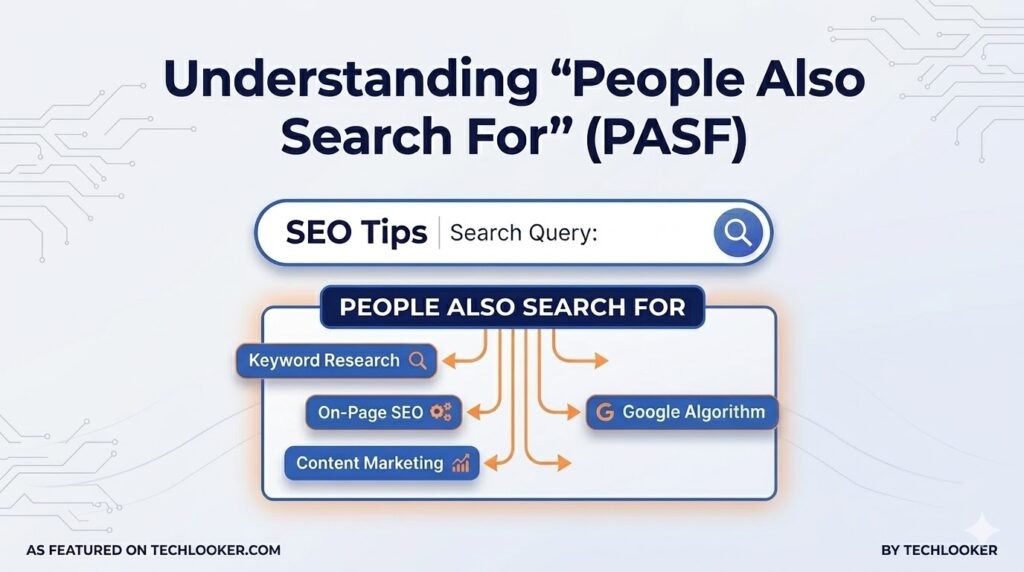
Introduction: The Google Feature That Most SEOs Are Leaving on the Table
If you’ve been doing SEO for any amount of time, you already know that Google’s search engine results pages (SERPs) are packed with data — AI Overviews, Featured Snippets, People Also Ask, Knowledge Panels, and more. But one feature that continues to fly under the radar for even experienced digital marketers in the United States is “People Also Search For” (commonly abbreviated as PASF).
You’ve seen it hundreds of times. You Google something, click a result, decide it’s not quite what you needed, hit the back button — and suddenly, right below the result you just visited, a new box appears with a cluster of related queries. That’s PASF in action.
What most SEOs don’t realize is that this seemingly small box is a direct window into Google’s understanding of search intent, related topics, and what users actually want when they type a query. For content creators, keyword researchers, and SEO strategists (or even expert SEO agency), PASF is one of the most underutilized yet powerful free data sources available.
In this comprehensive guide, we’ll cover everything you need to know about People Also Search For, including:
- What PASF is and how it works
- How PASF differs from People Also Ask (PAA)
- Why PASF matters for your SEO strategy in 2026
- 10 actionable ways to use PASF data to improve your content and rankings
- Tools to extract and scale PASF keyword research
- Common mistakes to avoid
- How to track your PASF-driven results
Let’s dive in.
- 1. What Is “People Also Search For” (PASF)?
- 2. How Does PASF Work?
- 3. Where Does PASF Appear on Google?
- 4. People Also Search For vs. People Also Ask: Key Differences
- 5. Why PASF Matters for SEO in 2026
- 6. Ten Proven Ways to Use PASF in Your SEO Strategy
- 7. Best Tools to Find PASF Keywords at Scale
- 8. Common PASF Mistakes to Avoid
- 9. How to Track PASF Performance
- 10. Final Thoughts: Make PASF a Core Part of Your SEO Toolkit
- 11. People Also Search For — FAQs
What Is "People Also Search For" (PASF)?
"People Also Search For" is a dynamic Google SERP feature that displays a set of related search queries when a user clicks a search result and then navigates back to the results page — a behavior commonly known as a "pogo stick" or "bounce back" action.
Introduced by Google around 2018, PASF was designed with one clear purpose: to help users who didn't find what they were looking for with their original query. When Google detects that a user returned to the SERP quickly after clicking a result (indicating dissatisfaction), it surfaces a cluster of related search terms underneath that result to guide the user toward more relevant options.
Think of PASF as Google's intelligent concierge service. If you walked into a store, picked up a product, put it down unsatisfied, and started heading for the exit — a smart salesperson would rush over to say, "Can I show you something that might be a better fit?" That's exactly what PASF does.
From an SEO standpoint, PASF represents real behavioral data — these are terms that users are actively pivoting to when a result fails to satisfy their intent. That makes them extraordinarily valuable for understanding:
- Topic clusters and semantic relationships between keywords
- Search intent variations around a core topic
- Content gaps in your existing pages
- Long-tail keyword opportunities with commercial or informational intent
How Does PASF Work?
Understanding the mechanics of PASF helps you use it more strategically.
Google's algorithm processes billions of search sessions daily. Through this data, Google identifies patterns: when users search for Term A, click Result X, return to the SERP quickly, and then search for Term B — Google learns that Terms A and B are semantically connected and that Result X may not fully satisfy the intent behind Term A.
Over time, Google builds a semantic knowledge graph of related queries — which queries tend to follow which, and which clusters of terms are often explored together during a single research session.
When you trigger PASF by bouncing back, Google is essentially surfacing the most common "next searches" taken by users in your situation, based on this aggregate behavioral data.
Key mechanics to understand:
- Bounce-triggered: PASF only appears after you click a result and return. It doesn't show up by default on the SERP.
- Behavioral, not random: The suggestions are based on real user behavior patterns, not simple keyword matching.
- Dynamic and personalized: PASF can vary depending on location, search history, device, and time of day.
- Mobile vs. Desktop: On desktop, PASF appears beneath the specific result you clicked back from. On mobile, it tends to appear lower in the scroll, sometimes in a carousel format.
Where Does PASF Appear on Google?
PASF can manifest in a few different formats depending on context:
Standard PASF Box: The most common format. Appears directly below the result you clicked after bouncing back. Displays 6–8 related search terms with small search icons next to each one. Clicking any of them loads a new SERP for that query.
PASF Carousel (Product/Brand Searches): For commercial searches (e.g., searching for a specific brand, product, or retailer), PASF often appears as a horizontal scrollable carousel featuring brand logos or product images.
PASF in "Explore" Panels: On mobile, PASF terms sometimes appear within exploratory content panels at the bottom of the SERP.
Related Searches Section: While not technically PASF, the "Related Searches" box at the bottom of any SERP page shares similar DNA — both are powered by Google's behavioral data and semantic clustering.
Understanding where and how PASF appears helps you use these data points more intelligently when building your keyword strategy.
People Also Search For vs. People Also Ask: Key Differences
This is one of the most common points of confusion among marketers, so let's clarify once and for all.
| Feature | People Also Search For (PASF) | People Also Ask (PAA) |
|---|---|---|
| Trigger | Appears after a user bounces back from a result | Appears proactively on the SERP for most queries |
| Format | List of related search terms with search icons | Accordion-style questions with expandable answers |
| Purpose | Help users find alternative search queries | Provide direct answers to related questions |
| Click Action | Loads a new SERP for the selected query | Expands an in-SERP answer (like a featured snippet) |
| SEO Value | Keyword research, topic clusters, intent mapping | Snippet opportunities, FAQ content, structured data |
| User Stage | Post-dissatisfaction refinement | Pre-click informational discovery |
In plain English:
- PASF shows you what to search next — it's about navigating to a new query.
- PAA shows you answers to related questions — it's about getting information without leaving the SERP.
Both are invaluable for SEO, but they serve different strategic purposes. PASF is best for keyword research and intent mapping; PAA is best for creating answer-optimized, structured content that can earn featured snippet real estate.
A smart SEO strategy in 2026 leverages both features together.
Why PASF Matters for SEO in 2026
The SEO landscape in 2026 is more competitive than ever. Google's AI Overviews are dominating zero-click searches, voice search is growing, and user intent is becoming increasingly nuanced. In this environment, understanding exactly what users want — and creating content that fully satisfies that intent — is the only sustainable path to organic growth.
PASF gives you a direct line into Google's own understanding of search intent clusters. Here's why that matters:
A. It Reflects Real User Behavior
Unlike keyword tools that estimate search volumes from historical data, PASF is derived from live, behavioral user signals. These are terms that real users are actually searching in sequence — which means they're contextually and intentionally linked.
B. It Reveals Semantic Relationships
Google has been moving away from keyword matching toward semantic understanding (entity recognition, topic modeling, natural language understanding). PASF reflects this semantic map — showing you which topics, entities, and questions Google considers related to your core keyword.
C. It Identifies Underserved Intent
When a user bounces back from a result, it means the content they found didn't fully satisfy their need. The PASF queries Google suggests are often underserved — meaning there's a content gap you can fill. Ranking for PASF-identified terms can drive meaningful organic traffic with less competition.
D. It Supports Topical Authority
Google's algorithms increasingly reward websites that demonstrate topical authority — deep, comprehensive coverage of a subject area. PASF helps you map the full landscape of subtopics, questions, and angles you need to cover to establish authority in your niche.
E. It Fuels AI-Era Content Strategy
With Google's AI Overviews and AI-powered generative search expanding rapidly, content that covers a topic comprehensively and answers multiple related intents in one page performs significantly better. PASF is your blueprint for building that kind of content.
Also Read: What Is GEO Generative Engine Optimization?
Ten Proven Ways to Use PASF in Your SEO Strategy
1. Find Powerful Long-Tail Keywords
Long-tail keywords — specific, multi-word search phrases — consistently outperform broad keywords in conversion rate, even if their search volume is lower. PASF is one of the best free sources of long-tail keyword ideas.
How to do it:
- Search your primary keyword on Google (e.g., "email marketing software")
- Click the first result, then immediately press Back
- Note the PASF terms that appear (e.g., "email marketing software for small business," "email marketing software free," "best email marketing software comparison")
- Plug these terms into a keyword research tool like Google Keyword Planner, Ahrefs, or Semrush to check volume and difficulty
- Build dedicated content pieces or optimize existing pages around the most promising terms
Long-tail keywords sourced from PASF are particularly valuable because they're already validated by real user behavior — Google is showing them to you because users are genuinely searching for them.
2. Improve Content Depth and Comprehensiveness
Google rewards content that thoroughly covers a topic from multiple angles. If your existing blog post only scratches the surface of a subject, PASF can show you exactly what additional subtopics and questions your content is missing.
Example: You publish a blog post on "content marketing strategy." By searching that term and reviewing PASF, you discover users are also searching for "content marketing strategy for B2B," "content marketing strategy examples," "content marketing ROI measurement," and "content marketing strategy template." Adding sections that address these angles transforms a thin post into a comprehensive resource — the kind Google loves to rank highly.
This is especially important in 2026, as Google's Helpful Content guidelines explicitly reward depth, expertise, and user satisfaction.
3. Conduct Content Gap Analysis
A content gap exists when your competitors are ranking for keywords that you're not covering at all. PASF makes content gap analysis fast and intuitive.
Process:
- Search your target keyword
- Click a competitor's ranking result, then bounce back
- Note their PASF box — these are topics related to their content that users are exploring
- Compare against your own content library
- Identify terms you haven't covered yet — those are your gaps
Repeat this process for your top 5–10 competitors and you'll have a roadmap for months' worth of new content.
4. Build Topic Clusters and Pillar Pages
Topic clusters are one of the most effective modern SEO structures. A pillar page covers a broad topic comprehensively, and multiple cluster pages dive deeper into specific subtopics — all interlinked.
PASF is perfect for mapping out your cluster structure. Your seed keyword becomes your pillar page, and each PASF term becomes a potential cluster page. This approach tells Google that your website has deep topical authority on the subject.
Example Cluster Structure using PASF:
- Pillar: "Local SEO Guide" (broad, comprehensive)
- Cluster pages: "Local SEO for restaurants," "Google Business Profile optimization," "Local citations guide," "Local SEO for law firms," "NAP consistency SEO" (all sourced from PASF)
5. Optimize for Search Intent Variations
Search intent isn't monolithic — users searching for similar things often want different outcomes. Some want to buy, some want to learn, some want to compare, some want to find a specific resource.
PASF reveals intent variations around your core topic. If PASF terms for "CRM software" include "CRM software comparison," "CRM software pricing," "free CRM software," and "CRM software for small teams" — you're seeing four distinct intent variants: comparison, transactional, freemium-seeking, and use-case-specific.
Create content that addresses each intent variant, and you'll capture a much broader slice of the search audience.
6. Discover New Blog Post Ideas
Running out of content ideas? PASF is an endless content idea engine. Every PASF box you generate contains 6–8 fresh content angles. Across dozens of seed keywords relevant to your industry, that's hundreds of validated content ideas — all confirmed by real user behavior.
Quick workflow:
- List 20 core topics relevant to your business
- Search each on Google, trigger PASF, and record all suggestions
- You'll have 120–160 content ideas ready to prioritize
The best platform to create new blog post and to manage easily is WordPress, even an amateur can operate and manage easily. Along with, you also need to focus on optimizing the blog post by doing SEO (ON & OFF Page) and especially for WordPress, perform WordPress SEO. Visit WordPress SEO Services to know more about the WordPress SEO and how it works.
7. Enhance Your Paid Search (PPC) Strategy
PASF isn't just for organic SEO — it's equally valuable for Google Ads keyword expansion. PASF terms show you exactly what queries users pivot to when ads or organic results don't satisfy them. These make excellent negative keywords (to exclude irrelevant traffic) or expansion keywords (to capture additional relevant searches).
SEO agencies and PPC teams that work in silos often miss these cross-channel insights. Using PASF data to bridge organic and paid strategy gives you a significant competitive advantage.
8. Strengthen Your Internal Linking Architecture
Internal linking is one of the most underrated on-page SEO tactics. When you link relevant pages on your site to each other, you help Google understand your site structure and distribute PageRank more effectively.
PASF helps you identify which of your existing pages are semantically related — and should therefore be linked. If PASF shows "keyword research tools" and "SEO content strategy" appear together, and you have pages on both topics, link them. It signals topical relevance and improves user navigation.
9. Improve Your FAQ Sections
FAQs are gold for SEO — they capture long-tail, conversational, and question-based queries that align perfectly with voice search and AI-generated answers. PASF is one of the best sources for building high-value FAQ content.
Combine PASF with People Also Ask data for your target keyword, and you'll have a comprehensive FAQ section that covers the full spectrum of user questions and follow-up queries. This type of content is highly likely to be pulled into AI Overviews and featured snippets.
10. Conduct Competitor Content Analysis
Want to know what angles are working for your top-ranking competitors? Click their result, bounce back, and review what PASF Google serves up. These are the topics Google associates with their content — and the subtopics their audience is exploring next.
Use this to reverse-engineer their content strategy, identify angles they've missed, and create better, more comprehensive content that outperforms them.
Best Tools to Find PASF Keywords at Scale
While you can manually trigger PASF on Google, scaling this research requires tools. Here are the best options for USA-based marketers:
1. Google Search (Manual Method)
The most direct approach. No cost, no setup. Simply search your keyword, click a result, press back, and document the PASF terms. Best for quick research on specific topics.
Limitation: Not scalable. Time-consuming for large keyword lists.
2. Google Keyword Planner
Once you identify PASF terms manually, use Google's free Keyword Planner to check search volumes and competition levels. Excellent for validating which PASF terms are worth targeting.
3. Ahrefs
Ahrefs' Keywords Explorer shows related terms, questions, and "Also rank for" keywords that closely mirror PASF data. Their "Related Terms" and "Parent Topic" features are particularly useful.
4. Semrush
Semrush's Keyword Magic Tool and Topic Research feature both surface semantically related queries that overlap heavily with PASF data. Their Keyword Gap tool is perfect for the content gap analysis workflow described above.
URL: Semrush Keyword Magic Tool
5. AnswerThePublic
Primarily focused on question-based keywords, AnswerThePublic maps out the full universe of questions, prepositions, and comparisons around any seed keyword — a valuable complement to PASF research.
URL: AnswerThePublic
6. AlsoAsked
Specifically designed to extract and visualize People Also Ask data, AlsoAsked also surfaces closely related semantic terms that overlap with PASF clusters.
URL: AlsoAsked
7. Nightwatch Keyword Research Tool
Nightwatch offers a free keyword research tool that lets you check search volumes and competition data for PASF terms quickly.
URL: Nightwatch Free Keyword Tool
Also Check: How SEO Reseller Services Help Agencies Scale Faster
Common PASF Mistakes to Avoid
Even seasoned SEOs make these mistakes when working with PASF data. Avoid them to get maximum ROI from your research:
Mistake #1: Treating All PASF Terms as Equally Valuable
Not every PASF term deserves a dedicated content piece. Always validate search volume, keyword difficulty, and business relevance before investing time in a new content asset.
Mistake #2: Ignoring Search Intent
Creating content that targets a PASF keyword but mismatches its search intent is a recipe for high bounce rates and poor rankings. Always ask: What does the user actually want when they search this term? Informational, navigational, commercial, or transactional?
Mistake #3: One-Time Research
PASF data evolves constantly as user behavior changes. Treat PASF research as an ongoing activity — schedule quarterly reviews of your key target topics to surface new opportunities.
Mistake #4: Neglecting to Connect PASF to Your Content Calendar
PASF research generates a lot of ideas fast. Without a system for organizing and prioritizing them (a content calendar, a keyword tracking spreadsheet, a project management tool), these insights will sit unused.
Mistake #5: Using PASF in Isolation
PASF is most powerful when used alongside other data sources — PAA, Related Searches, Google Search Console data, and keyword research tools. A holistic approach always beats a siloed one.
Mistake #6: Targeting PASF Keywords Without On-Page Optimization
Identifying a great PASF keyword is only half the battle. You still need to optimize your content with proper title tags, meta descriptions, header structure, internal links, and structured data.
How to Track PASF Performance
After implementing a PASF-driven keyword strategy, measurement is critical. Here's how to track your results:
1. Google Search Console
Monitor impressions, clicks, and average position for PASF-targeted keywords. Filter by specific queries in the Performance report to track individual keyword progress.
2. Rank Tracking Tools
Use a rank tracker (Ahrefs, Semrush, Nightwatch, Moz) to monitor daily/weekly rankings for your target PASF keywords. Set up alerts for significant ranking changes.
3. Organic Traffic Analysis (Google Analytics 4)
Track organic sessions to pages optimized with PASF keywords. Monitor engagement metrics (bounce rate, session duration, pages per session) to assess content quality and intent alignment.
4. SERP Feature Monitoring
Track whether your optimized pages are appearing in PAA boxes, Featured Snippets, or AI Overviews — all SERP features that become more attainable when you create intent-rich, comprehensive content guided by PASF research.
5. Content Gap Closure Rate
If you're using PASF for content gap analysis, track what percentage of identified gaps you've filled over time and correlate that with overall organic traffic growth.
Final Thoughts: Make PASF a Core Part of Your SEO Toolkit
"People Also Search For" is far more than a navigational aid for Google users. For SEO professionals and content marketers in the USA and beyond, it's a real-time behavioral intelligence tool that reveals exactly how Google categorizes your topic, what related intents exist around your core keywords, and where your content strategy has gaps.
In 2026, the difference between mediocre and exceptional SEO performance often comes down to how deeply you understand your audience's intent — and how comprehensively your content serves that intent. PASF gives you the map. It's up to you to follow it.
Key takeaways from this guide:
- PASF is triggered when a user bounces back from a search result, signaling dissatisfaction
- It's powered by real behavioral data and reflects Google's semantic understanding of related topics
- PASF differs from People Also Ask in trigger mechanism, format, and SEO use case
- The ten strategies above — from long-tail keyword discovery to competitor analysis — can each drive measurable SEO gains
- Combining PASF with tools like Ahrefs, Semrush, and Google Search Console maximizes your research ROI
- Track performance via GSC, rank trackers, and GA4 to measure impact over time
Ready to take your SEO to the next level? At Techlooker, we help businesses across the USA, Canada and Globally harness data-driven SEO strategies — from keyword research and content optimization to technical audits and link building. Our team of SEO experts knows how to turn features like PASF into real competitive advantages. Fill a form for Free Call for SEO Consulting Services.
People Also Search For — FAQs
"People Also Search For" (PASF) is a Google Search feature that surfaces a set of related search queries directly below a search result that a user has clicked on and then navigated away from (i.e., bounced back from). It was introduced by Google around 2018 as a UX enhancement to help users who didn't find what they were looking for on their first click.
What makes PASF unique compared to other SERP features is its trigger mechanism and behavioral foundation. Unlike most SERP features that are visible to all users on all searches, PASF only appears after Google detects a dissatisfaction signal — specifically, when a user returns to the SERP quickly after clicking a result. This makes PASF a reactive feature rather than a proactive one.
Here's how it stacks up against other Google SERP features you've likely heard of:
- Featured Snippets are proactively pulled from specific pages to answer a query directly at the top of the SERP. They're about showcasing the best answer. PASF, by contrast, doesn't pull answers — it suggests alternative queries.
- People Also Ask (PAA) is a proactive, expandable question-and-answer box that appears for most informational queries. It shows questions related to the search and provides short answers pulled from ranking pages. PASF shows related search queries (not questions with answers) and is only triggered post-bounce.
- Related Searches appears at the bottom of every SERP page. It's always visible and covers broadly related terms. PASF is more contextual — it appears mid-SERP, tied to the specific result you bounced from, and reflects tighter semantic clustering.
- AI Overviews(formerly SGE) are Google's AI-generated summaries that appear at the top of SERPs for certain queries. They synthesize multiple sources into one answer. PASF operates entirely separately from this AI layer — it's purely a query-navigation tool.
In summary, PASF occupies a unique niche: it's intent-refinement data derived from real behavior, making it one of the most authentic and practically useful data sources for SEO professionals. It tells you not just what people search for, but what they search for when their first attempt fails — which is arguably more telling about true user intent than almost any other signal.
This is one of the most common points of confusion, and while both features draw on Google's behavioral and semantic data, they are meaningfully different in several important ways.
"Related Searches" appears as a block of 6–8 search suggestions at the very bottom of every Google SERP, regardless of whether the user has clicked on any result. It's always present, always visible, and represents Google's general topical associations with your query. Think of it as a broad semantic map of the topic neighborhood.
"People Also Search For" (PASF), by contrast:
- Only appears mid-SERPafter a user clicks a result and quickly returns to the SERP
- Is tied to a specific result— the PASF box appears beneath the particular result you bounced from, not at the bottom of the page
- Is more narrowly targeted— because it's triggered by dissatisfaction with a specific result, the terms it shows are typically more closely related to the specific angle or subtopic that result covered (or failed to cover adequately)
- Reflects dissatisfaction signals— whereas Related Searches reflects broad topical connections, PASF reflects what users actually searched for after they were disappointed
From an SEO strategy standpoint, both are valuable but serve different research purposes:
- Use Related Searches for broad topic mapping and discovering adjacent themes to build topical authority around
- Use PASF for identifying specific content gaps, underserved intent angles, and high-value long-tail keywords where existing content is failing users
Another practical difference: Related Searches is easier to access (always visible) and therefore more commonly used in SEO research. PASF requires actively triggering the feature by clicking and bouncing — making it slightly harder to access at scale, but arguably more valuable precisely because fewer marketers are mining it systematically.
This is an important question that deserves a nuanced answer. PASF itself doesn't directly cause your pages to rank higher — but targeting PASF keywords as part of your content strategy absolutely can improve your rankings, and here's the mechanism:
When users click a PASF suggestion, Google loads a completely new SERP for that query. Your page can then rank on that new SERP if you've created content that targets that PASF keyword. So the path to improved rankings via PASF is:
- Identify PASF keywords relevant to your topic
- Create or optimize content that targets those keywords with the right intent match
- Rank on the SERPs that appear when users click those PASF suggestions
- Capture traffic from users who are actively searching for what you've created
Beyond direct ranking for PASF-identified keywords, there's a secondary benefit: content that comprehensively covers a topic (including PASF-suggested angles) tends to perform better overall because it satisfies a wider range of search intents. Google's Helpful Content system rewards pages that leave users fully satisfied — and PASF research helps you understand exactly what "fully satisfied" looks like for your topic area.
There's also an indirect ranking benefit through topical authority. When you consistently publish content that covers not just a core topic but all the related angles that PASF reveals, Google recognizes your website as a comprehensive resource on the subject. This strengthens your domain authority within that topic cluster and can lift rankings across all your related content — not just the individual PASF-optimized pages.
Finally, PASF research can help you reduce pogo-sticking on your own pages. If users frequently bounce from your result back to the SERP and click a PASF suggestion, that's a user engagement signal Google may interpret as dissatisfaction with your content. By proactively addressing PASF topics within your content, you reduce bounce-backs, increase dwell time, and send stronger positive engagement signals to Google.
PASF data is dynamic and changes regularly, though not as rapidly as real-time trending data like news or stock prices. The frequency of change depends on several factors:
Factors that cause PASF data to shift:
- Seasonal trends: Search behavior changes significantly by season. A query like "HVAC maintenance" will surface different PASF terms in January (heating-focused) versus July (cooling-focused). Businesses in seasonal industries should review PASF data at the start of each season.
- News and trending events: Major industry developments, product launches, algorithm updates, or cultural moments can rapidly shift what users search for in sequence. For example, after a major Google algorithm update, searches for "SEO best practices" might suddenly surface PASF terms related to the update itself.
- Evolving user behavior: As more users interact with a topic over time, the aggregate behavioral patterns that power PASF shift. A term that was in PASF six months ago may no longer appear today, and new terms may have emerged.
- Content landscape changes: If major new content resources are published in your niche (think comprehensive guides, research reports, or viral blog posts), user behavior around related queries can shift, changing PASF suggestions.
- Google algorithm updates: Google periodically refines how it clusters and surfaces PASF terms as part of broader algorithm improvements.
Recommended review cadence:
- Quarterly reviews for most evergreen topics — check PASF for your primary target keywords every three months and update your content calendar accordingly
- Monthly reviews for fast-moving industries like tech, finance, health, and digital marketing
- Before every major content project — always check fresh PASF data for any keyword you're about to invest significant content resources in
- After major Google algorithm updates — these can shift PASF clusters noticeably, so run a PASF audit of your top keywords within two weeks of any confirmed major update
Building PASF review sessions into your regular SEO workflow ensures you're always working with current data and never missing emerging keyword opportunities.
Absolutely — and in many ways, small businesses and startups stand to benefit MORE from PASF than large enterprises. Here's why:
Large enterprises typically have substantial keyword research budgets, access to premium SEO tools, and dedicated teams running continuous competitive analysis. They're already uncovering many keyword opportunities through paid tools and extensive research processes. For them, PASF is a useful supplement to an already robust system.
For small businesses and startups operating with limited budgets, PASF represents a completely free, real-time behavioral data source that levels the playing field. You don't need a $500/month Ahrefs subscription to identify valuable PASF keywords — you just need a Google account and a systematic approach to manual PASF research.
Specific ways small businesses in the USA can leverage PASF:
- Local keyword discovery: A small roofing company in Dallas can search "roof repair Dallas," trigger PASF, and discover hyper-local long-tail variations like "affordable roof repair Dallas TX," "emergency roof repair Dallas," or "Dallas roof repair after hail storm." These local long-tail terms are often far less competitive than broad terms and can be relatively easy to rank for with well-optimized local content.
- Niche market understanding: Startups entering a new market can use PASF to rapidly understand the vocabulary, concerns, and subtopics that define their target audience's search behavior — without needing expensive market research tools.
- Content prioritization with limited resources: Rather than creating content on every possible topic, small businesses can use PASF to identify the most urgent and underserved topics their audience is searching for. This helps maximize the ROI of every piece of content created.
- Competitor gap analysis on a budget: By searching competitor brand names and triggering PASF, small businesses can discover what users look for after visiting competitor content — and position their own content as a better alternative.
The bottom line: PASF is a democratizing tool. With time, consistency, and a smart workflow, a one-person marketing team can extract the same quality of PASF insights as an enterprise SEO department. The advantage goes to whoever is more systematic and strategic in how they apply the data.
Ecommerce SEO has unique characteristics that make PASF especially powerful. When users search for products online and bounce back from a product listing or category page, the PASF suggestions Google serves up reveal extraordinarily valuable commercial intent signals. Here's a detailed breakdown of how ecommerce businesses should be using PASF:
- Product Page Optimization: When you search for a specific product (e.g., "wireless noise cancelling headphones") and trigger PASF, you'll typically see terms like "wireless noise cancelling headphones under $100," "wireless noise cancelling headphones for travel," "best wireless noise cancelling headphones 2026," and "wireless noise cancelling headphones vs earbuds." These are the exact comparison and specification queries your product pages should address in their descriptions, FAQs, and feature sections.
- Category Page Strategy: PASF for broad category searches (e.g., "men's running shoes") often reveals subcategories users are looking for — "men's running shoes for wide feet," "men's running shoes for flat feet," "lightweight men's running shoes for marathon." Each of these could justify a dedicated subcategory page or a targeted landing page with filtered product results.
- Blog Content for Top-of-Funnel Traffic: Ecommerce brands that invest in content marketing can use PASF to identify informational queries that attract top-of-funnel shoppers. Someone searching "how to choose running shoes" who bounces and sees PASF terms like "running shoe features explained" or "running shoes vs training shoes difference" is in early research mode. Creating helpful content that answers these queries builds brand trust and warms up potential buyers before they're ready to purchase.
- Brand Competitor Research: Search a competitor's brand name, trigger PASF, and you'll see terms like "[Competitor] vs [Alternative]," "[Competitor] reviews," "[Competitor] cheaper alternative." These are queries from users who are actively comparison-shopping — a perfect audience for your own brand comparison or alternative landing pages.
- Seasonal Promotions Planning: Check PASF for your product categories in advance of major US shopping events (Black Friday, Cyber Monday, Prime Day, Back to School). The PASF terms that surface around these periods reveal exactly what deal-related, comparison, and specification queries shoppers are pivoting to — helping you plan promotional content in advance.
- Reducing Cart Abandonment Through Better Product Content: If users are bouncing from your product pages and PASF shows they're then searching for "[product] reviews" or "[product] vs [competitor product]," that's a signal that your product pages need more social proof, comparison content, or detailed specifications. PASF essentially tells you what information your product pages are missing.
This is one of the most forward-looking questions in modern SEO, and PASF plays a surprisingly important role in understanding how to win in the AI-powered search era.
Google's AI Overviews (the AI-generated summaries that now appear at the top of many SERPs) represent a fundamental shift in how search results are presented. Instead of users always clicking through to individual websites, AI Overviews synthesize information from multiple sources into a single comprehensive response — directly in the SERP.
This shift makes it more important than ever to create content that is comprehensive, authoritative, and multi-faceted. And that's precisely where PASF becomes more valuable, not less. Here's why:
- PASF reveals what "comprehensive" looks like for your topic: When Google's AI generates an Overview for a query, it draws from content that covers the full breadth of that topic — including the subtopics and related angles that PASF reveals. Pages that only cover the narrow core of a topic are less likely to be sourced in AI Overviews than pages that holistically address the topic cluster.
- PASF data feeds into semantic entity optimization: Google's AI understands content through entities and semantic relationships — not just keyword matching. PASF terms represent the semantic neighborhood of your core topic as Google understands it. Incorporating PASF-identified entities and subtopics into your content signals to Google's AI that your page is a thorough, authoritative resource — exactly the kind of content AI Overviews draw from.
- PASF helps you anticipate multi-turn AI queries: As conversational AI search grows (think Google's AI mode, voice search, ChatGPT-style interactions), users increasingly ask follow-up questions in a single session. PASF data reflects the natural progression of these follow-up queries. Content that pre-emptively answers these follow-ups is better positioned for AI-driven search environments.
- The "zero-click" challenge and PASF: AI Overviews are increasing zero-click searches — meaning users get their answer without visiting any website. PASF research helps you identify query types where users are more likely to still click through (complex research queries, product comparisons, how-to guides) versus simple factual queries that AI can answer entirely. Focus your content investment on the click-worthy angles that PASF reveals.
In 2026 and beyond, PASF isn't becoming obsolete — it's becoming more strategically important as the mechanism for understanding what truly comprehensive, intent-satisfying content looks like in an AI-first search world.
For SEO professionals and small business owners who want to leverage PASF without investing in premium tools, manual extraction is entirely viable when done systematically. Here's a detailed, step-by-step best practice guide:
- Use Incognito/Private Browsing Mode: Always conduct PASF research in an incognito window. This prevents your personal search history and Google account data from personalizing the results, giving you a more accurate representation of what a typical US user would see for that query.
- Set Your Location Correctly: For US-targeted PASF research, ensure Google is set to the appropriate US location. You can manually set your location in Google Search Settings, or use a VPN with a US server if you're conducting research from outside the United States.
- Prepare Your Seed Keyword List: Before starting, compile a list of 10–30 core seed keywords relevant to your business, organized by topic cluster. This keeps your research session focused and ensures comprehensive coverage.
- Execute the Trigger Sequence: For each seed keyword: (a) Type the keyword into Google and press Enter; (b) Click the first or second organic result; (c) Immediately press the Back button in your browser; (d) Observe and record the PASF box that appears below the result you just left.
- Record Everything in a Spreadsheet: Create a simple Google Sheet or Excel spreadsheet with columns for: Seed Keyword, PASF Term 1 through PASF Term 8, Date Researched, Notes/Intent Type. Record every PASF suggestion — even ones that seem irrelevant at first glance, as they often reveal unexpected angles.
- Repeat for Multiple Results: Don't stop at the first result. Trigger PASF for the top 3–5 results for each seed keyword. Different results may yield different PASF suggestions, giving you a more complete picture of the keyword's semantic neighborhood.
- Categorize by Intent Type: Once you've collected your PASF data, go through your spreadsheet and tag each term by intent type: Informational, Commercial, Transactional, Navigational, or Local. This categorization guides content type decisions (blog posts vs. landing pages vs. product pages).
- Prioritize by Content Gap: Cross-reference your PASF terms against your existing content library. Terms that don't match any existing content are your highest-priority opportunities.
- Validate With Free Volume Tools: Use Google Keyword Planner (free with a Google Ads account) to check approximate search volumes for your prioritized PASF terms before committing to content creation.
- Schedule Regular Research Sessions: Block 1–2 hours per month for PASF research sprints. Consistency is more valuable than intensity — regular small sessions will build a richer keyword database over time than infrequent marathon research days.
Over three to six months, this process will give you a deep, current, and actionable PASF-based keyword map for your entire content strategy — all without spending a dollar on premium tools.
Voice search has steadily grown as a dominant search modality, particularly in the United States where smart speakers and voice assistants (Siri, Alexa, Google Assistant) are embedded in daily life. A significant percentage of US searches are now conducted via voice — and that figure continues to grow as AI assistants become more sophisticated.
Why PASF is uniquely valuable for voice search optimization:
Voice searches are inherently conversational and sequential. When someone asks their smart speaker a question, they often follow it up with related questions in the same session — exactly the kind of sequential search behavior that PASF captures. The terms that appear in PASF boxes closely mirror the follow-up questions users ask in voice search sessions.
Practical applications:
- Natural language keyword integration: PASF terms for voice-relevant queries tend to be phrased in natural, conversational language — "how do I fix a leaky faucet myself," "what's the cheapest way to fix a leaky faucet," "should I call a plumber or fix it myself." These are far more conversational than traditional typed keywords, making them perfect for voice search content optimization.
- Long-form question targeting: Voice search queries are typically longer and more question-based than typed queries. PASF frequently surfaces these long-form question variants. Incorporating them as H2/H3 subheadings in your content, followed by direct conversational answers, optimizes your pages for both voice search and PAA snippet eligibility.
- Featured snippet capture for voice results: Most voice search answers are pulled directly from featured snippets. Content that comprehensively answers PASF-identified follow-up questions — formatted in concise, direct answer blocks — has a strong chance of being selected as a featured snippet and therefore spoken aloud by voice assistants.
- Local voice search optimization: PASF is particularly powerful for local voice searches in the USA. Queries like "best pizza near me" trigger PASF terms like "best pizza near me open now," "best pizza near me with delivery," "best pizza near me under $20." These hyper-specific local PASF variations match exactly how people phrase voice queries when they're hungry, on the go, and looking for immediate answers. Incorporating these into your Google Business Profile content, local landing pages, and blog posts maximizes voice search visibility.
Content format recommendation for voice + PASF:
Structure content using a Question → Direct Answer → Supporting Detail format. The direct answer (2–3 sentences) immediately after each question heading is what voice assistants pull. The supporting detail satisfies users who read the full page. This format simultaneously optimizes for voice search, featured snippets, PAA boxes, and AI Overviews — the four most prominent SERP features in 2026.
Most SEO guides focus exclusively on PASF for written content — blog posts, landing pages, and articles. But PASF is equally valuable for YouTube SEO and video content planning, and this is an angle that even experienced video marketers often overlook.
Why YouTube video content benefits from PASF:
YouTube is the second-largest search engine in the world, and Google increasingly surfaces YouTube videos directly within Google SERPs (in video carousels, featured video snippets, and AI Overviews). The semantic relationship between Google search queries and YouTube video content is tighter than ever. This means PASF data from Google searches directly informs what YouTube video content your audience is looking for.
How to apply PASF to your YouTube strategy:
- Video Title and Description Optimization: PASF terms are excellent sources for YouTube video titles and descriptions. If you're creating a video about "content marketing strategy," and PASF reveals terms like "content marketing strategy for beginners," "content marketing strategy examples," and "content marketing strategy ROI," you can create individual videos targeting each angle — or incorporate these phrases naturally into a single comprehensive video's title, description, and tags.
- Video Series Planning: PASF clusters map perfectly to YouTube series or playlist structures. A series of videos, each addressing one PASF-identified subtopic of your core theme, creates a content cluster that keeps viewers watching multiple videos in sequence — improving watch time, subscriber conversion, and YouTube algorithm favorability.
- Video Chapter Markers: For longer YouTube videos (10+ minutes), PASF terms can serve as chapter markers. Each PASF-identified subtopic becomes a timestamped chapter, making your video more navigable and more likely to appear as a video rich result in Google's SERP with chapter previews.
- Cross-Platform Content Repurposing: If you've already created blog content targeting PASF keywords, those same keywords can guide your video scripts — turning written content into video content that captures a different audience segment. This maximizes the ROI of every PASF keyword you identify.
- YouTube Shorts and PASF: For YouTube Shorts (vertical short-form videos), PASF terms that are simple, question-based queries are ideal content prompts. A 60-second video that directly and clearly answers a PASF question can earn significant views from both YouTube search and Google's video snippets.
The combined Google + YouTube PASF workflow:
- Research PASF terms for your core topic on Google
- Search the same terms on YouTube to see what video content already exists
- Identify gaps where PASF-identified queries have no strong video content yet
- Create YouTube videos targeting those gaps
- Embed those YouTube videos in corresponding blog posts on your website
- Build a cross-platform, mutually reinforcing content ecosystem that dominates both Google and YouTube SERPs for your target topics
Link building is one of the most powerful and most difficult aspects of SEO. High-quality backlinks from authoritative websites remain one of Google's top ranking signals. Most link building guides focus on tactics like guest posting, broken link building, and resource page outreach. What's rarely discussed is how PASF data can make every link building tactic significantly more effective.
Here's how PASF supports link building and digital PR:
- Creating Link-Worthy Content With PASF-Informed Angles: The most effective link-building strategy is creating content that other websites want to link to — comprehensive guides, original research, data-driven posts, and authoritative resources. PASF helps you identify the specific angles, questions, and subtopics that make content truly comprehensive. A guide that addresses not just the core topic but every PASF-identified related angle is far more likely to be cited as a resource than a superficial overview.
- Identifying Outreach Opportunities Through PASF Competitor Research: Search competitor brand names and trigger PASF. The resulting terms often reveal topics your competitors have published about and received links for. By creating better, more comprehensive, and more current content on those same topics, you can reach out to the same sites linking to your competitors and pitch your superior resource.
- Digital PR Pitch Development: Digital PR involves getting your content featured in online publications, news sites, and industry blogs. PASF data reveals what topics reflect real audience curiosity. Use PASF to identify trending angles in your industry, create original research or expert commentary on those topics, and pitch them to relevant US media outlets.
- Guest Post Topic Selection: When pitching guest post ideas to industry blogs and publications, PASF provides a shortlist of topics already validated by real user interest. Pitching a guest post on a PASF-identified subtopic (rather than a generic topic) demonstrates that you understand the publication's audience — dramatically improving your pitch acceptance rate.
- Resource Page Link Building: Many websites maintain resource pages — curated lists of the best guides and tools in a given industry. PASF helps you identify every subtopic angle your resource must cover to be genuinely comprehensive. A resource that thoroughly addresses every PASF-identified angle is far more likely to earn placements on industry resource pages.
- HARO and Expert Contributor Opportunities: PASF can help you identify trending questions in your industry that journalists and bloggers are researching through platforms like HARO (Help a Reporter Out) and similar journalist query services. By monitoring PASF for your core topics, you stay ahead of the questions journalists will ask — positioning you to provide timely, relevant expert quotes that earn high-authority backlinks.
Google's E-E-A-T framework — which stands for Experience, Expertise, Authoritativeness, and Trustworthiness — is one of the most important quality evaluation criteria used by Google's human quality raters. While E-E-A-T is not a direct ranking factor, it strongly influences which content Google promotes in rankings and which content it suppresses.
Understanding the relationship between PASF and E-E-A-T reveals why PASF-driven content strategy is so powerful:
- Experience: Google wants content created by people with first-hand experience. PASF research helps you understand the full breadth of user questions and concerns. Crafting comprehensive, experience-backed answers to all PASF-identified angles demonstrates genuine depth — not just surface-level content. When your page anticipates real-world follow-up questions, it signals practical knowledge.
- Expertise: PASF reveals technical subtopics, nuanced angles, and deeper questions within a subject. Content that confidently and accurately addresses these PASF-identified subtopics demonstrates subject matter expertise far more convincingly than content that only covers obvious basics.
- Authoritativeness: Authority is built through consistent, comprehensive topical coverage. By systematically using PASF to identify and fill content gaps, you create dense topic clusters that signal genuine topical authority. Websites with strong topical authority often receive broader ranking strength across related keywords.
- Trustworthiness: Content that fully answers follow-up questions — including skeptical comparisons and “what if” scenarios surfaced by PASF — builds user trust. When readers see that your content anticipated and answered their next question before they asked it, brand credibility increases significantly.
Practical E-E-A-T + PASF workflow:
- Use PASF to identify every angle users explore around your topic
- Ensure your content addresses each angle with depth, accuracy, and original insight
- Attribute content to credentialed authors where appropriate (especially for YMYL — Your Money Your Life — topics like health, finance, and legal)
- Include author bios, cite primary sources, and link to authoritative external resources
- Build internal links that demonstrate your website's comprehensive topical coverage
The result: Content that doesn’t just rank temporarily — it earns and maintains its position over time because it genuinely satisfies E-E-A-T criteria at every level.
Local SEO is a critical growth driver for service-based businesses across the United States — from plumbers and dentists in New York to landscapers and personal injury lawyers in Texas. PASF is one of the most underutilized local SEO research tools available, and service businesses that master it gain a significant edge over competitors who rely on generic keyword lists.
Why PASF is especially powerful for local service businesses:
Local users searching for service providers have very specific, intent-rich queries. They often bounce from results that feel too generic, too expensive, too far away, or too specialized (or not specialized enough). This bounce-and-search behavior generates rich PASF data that directly reflects what local users truly want.
Step-by-step local SEO PASF workflow:
- Research location-specific PASF terms: Search "[your service] + [your city/region]" (e.g., "emergency plumber Chicago," "family dentist Austin TX," "personal injury lawyer Miami") and trigger PASF. Record all suggestions.
- Identify hyper-local long-tail variations:
Common PASF patterns for local service searches include:
- "[Service] near me open now" — urgency and availability intent
- "[Service] [city] affordable/cheap/low-cost" — price sensitivity intent
- "[Service] [city] reviews" — trust-building research intent
- "[Service] [city] vs [city]" — comparison intent (useful for multi-location businesses)
- "[Service] licensed/certified [city]" — credential verification intent
- "Best [service] [neighborhood name]" — neighborhood-specific intent
- Create neighborhood and area-specific landing pages: If PASF reveals strong neighborhood-level search intent (e.g., "HVAC repair Bucktown Chicago" appearing as PASF for "HVAC repair Chicago"), create dedicated landing pages for each neighborhood or suburb you serve. These hyper-local pages are often significantly easier to rank for than broad city-level pages.
- Optimize Google Business Profile with PASF insights: Use PASF-identified terms to inform your Google Business Profile — especially in the business description, services section, and Q&A section. These terms also work well for Google Business Profile posts, which can improve local pack visibility.
- Create FAQ content addressing PASF local queries: Transform PASF-identified local queries into FAQ content on your service pages and blog. Examples include: "How much does roof repair cost in Dallas?" or "What should I look for in a licensed electrician in Phoenix?" These high-intent queries are strong candidates for featured snippet placement in local search results.
- Build local content clusters: Use PASF to create a local content cluster: a main location page (e.g., "Plumber in Denver") supported by cluster pages on related local topics (e.g., "Emergency plumber Denver," "Water heater repair Denver," "Denver plumber cost guide"). Interlink them strategically for maximum local SEO impact.
Both Google Autocomplete and People Also Search For (PASF) are behavioral data features powered by Google's massive search dataset, but they reflect user behavior at very different points in the search journey. Understanding this difference helps you use each more strategically.
Google Autocomplete:
- Appears before a user submits a search query, as they type in the search bar
- Predicts what the user is about to search based on popular completions of partial queries
- Reflects the most common completed queries that start with the typed characters
- Best for: Discovering popular query variations and entry points around a seed keyword
People Also Search For (PASF):
- Appears after a user has searched, clicked a result, and returned to the SERP
- Reflects what users search for next when they were not satisfied with their initial result
- Best for: Identifying underserved intent angles and improving comprehensive topic coverage
The key conceptual difference:
Autocomplete tells you how users begin their search journey. PASF tells you how they continue it when things don’t go as planned. Together, they provide a complete picture of the user journey — from first query to final satisfaction.
Should you use both for keyword research?
Absolutely yes. Here's how to combine them effectively:
| Research Stage | Best Tool | What You Learn |
|---|---|---|
| Topic discovery | Google Autocomplete | Popular query variations and entry points |
| Intent refinement | PASF | What users look for when unsatisfied |
| Question mining | People Also Ask | Specific questions users want answered |
| Broad topic mapping | Related Searches | Adjacent topics and theme clusters |
| Volume validation | Google Keyword Planner | Search volume and competition data |
A comprehensive keyword research session should cycle through all five of these data sources. Start with Autocomplete to discover your keyword landscape, use PASF to identify gaps and underserved angles, mine People Also Ask for question-based content opportunities, check Related Searches for broader topical adjacencies, and validate everything with volume data.
This multi-source approach creates a richer, more nuanced keyword map than any single method alone — and it’s almost entirely free using native Google features.
Manual PASF research — clicking results and recording suggestions one by one — is effective but time-consuming. For large websites, agencies managing multiple clients, or SEO teams working with extensive keyword lists, scaling this research requires a more systematic approach.
Scaling strategies for PASF research:
- Batch Research Sessions With a Template: Create a dedicated Google Sheet or Airtable database with pre-populated seed keywords. During focused research sprints (2-hour blocks), work through 20–30 keywords systematically, recording PASF data in real time. A well-structured template can often be completed for 30 keywords in under two hours.
- Delegate to Team Members With Clear SOPs: Document your PASF research process as a standard operating procedure (SOP) with screenshots, step-by-step instructions, and quality guidelines. Entry-level SEO team members or virtual assistants can execute PASF research at scale once they have a clear process to follow.
- Use SEO Tools That Approximate PASF Data:
While no tool replicates PASF exactly (since it requires triggering the bounce signal), several premium SEO tools provide closely related data at scale:
- Ahrefs' "Also rank for" and "Related terms" features
- Semrush's Keyword Magic Tool topic clusters
- Serpstat's Search Questions and related keywords reports
- KeywordTool.io for bulk related query suggestions
- Automate Data Organization With Google Sheets: Once you have PASF data collected (manually or via tool exports), use Google Sheets formulas, pivot tables, and conditional formatting to quickly identify patterns, cluster related terms, and prioritize by topic gap and commercial value.
- Prioritize by Topic, Not Individual Keywords: Rather than researching PASF for every single keyword individually, group keywords by topic cluster and research the top 3–5 representative keywords per cluster. PASF terms for related keywords within a cluster often overlap significantly, allowing you to capture most of the value with a fraction of the research effort.
- Quarterly Refresh Cycles: Instead of maintaining real-time PASF data for hundreds of keywords, establish quarterly refresh cycles. Every three months, re-research PASF for your highest-priority keyword clusters and update your content calendar accordingly. This keeps your data current without requiring continuous research.
- Integrate PASF Into Your Content Briefing Process: Make PASF research a mandatory step in your content brief template. Before assigning content to a writer, ensure the SEO team has already researched PASF for the target keyword and included the most relevant PASF-identified subtopics in the brief. This ensures every piece of content is strategically informed from the start.
You just Googled something, clicked the first result, realized it wasn't quite what you needed, and pressed the Back button. A second later, a small row of keyword chips appeared under that original listing — almost like Google whispering, "Did you mean one of these instead?"
That feature is called People Also Search For (commonly abbreviated as PASF), and most content marketers barely know it exists. Yet it is one of Google's clearest windows into exactly what users actually want.
In this guide — the most comprehensive resource on PASF available in 2025 — you will learn what PASF is, why it matters, how Google generates it, how to extract PASF keywords at scale, and most importantly, how to weave them into your content strategy to drive real rankings.
✦ What You'll Learn in This Guide
- The exact definition of People Also Search For (PASF) and how it's triggered
- How PASF differs from People Also Ask, Related Searches, and Autocomplete
- The SEO importance of PASF keywords — backed by data
- 5 proven strategies to find and use PASF keywords at scale
- The best PASF tools in 2025 — free and paid
- Common PASF mistakes and how to fix them
- A complete FAQ answering every question about PASF
1. What Is "People Also Search For" (PASF)?
People Also Search For (PASF) is a Google Search feature that appears on the Search Engine Results Page (SERP) as a cluster of related search query suggestions. Unlike most SERP features, PASF is uniquely behavior-triggered — it shows up specifically when a user:
- Performs a search query on Google
- Clicks on an organic search result
- Returns to the SERP page by pressing the browser's Back button
- Arrives back at the results page to see PASF chips appearing under the result they just visited
The PASF section displays a set of keyword chips — typically 6 to 8 — that represent semantically related queries other searchers explored for the same topic. These chips are clickable and launch a new search for that specific keyword.
↑ Example of how PASF appears on a Google SERP after pressing the Back button
The Exact Trigger Condition
This is the most misunderstood aspect of PASF. Unlike "Related Searches" (which appears at the bottom of every SERP automatically), PASF is not always visible on the initial SERP. It only appears under a specific result listing after the user bounces back from that page.
This behavior-based trigger makes PASF an incredibly valuable dataset — because it reflects what real users actually searched for next when they didn't find what they wanted on a particular result. It's essentially Google's implicit dissatisfaction signal turned into a keyword goldmine.
2. PASF vs. People Also Ask vs. Related Searches vs. Autocomplete
Google has multiple "related content" features, and they all serve different purposes. Confusing them is one of the most common mistakes SEO beginners make.
| Feature | Where It Appears | When Triggered | Format | SEO Use |
|---|---|---|---|---|
| People Also Search For (PASF) | Under a specific result on SERP | After user clicks + bounces back | Clickable keyword chips | Intent expansion, content gap |
| People Also Ask (PAA) | In the middle of SERP | On every SERP load (for eligible queries) | Expandable Q&A accordion | Featured snippet, FAQ content |
| Related Searches | Bottom of SERP page | Every SERP, always visible | Linked keyword list | Keyword research, LSI terms |
| Autocomplete / Search Suggestions | Google search bar dropdown | As user types query | Dropdown suggestions | Long-tail keyword discovery |
| Knowledge Panel | Right sidebar of SERP | For entities/brands Google recognizes | Info card with facts | Brand authority, entity SEO |
3. Why Does PASF Matter for SEO? (The Data Will Surprise You)
Most SEO guides mention PASF as an afterthought — a footnote in the keyword research chapter. This is a serious mistake. Here's why PASF deserves to be at the center of your content strategy:
Why PASF Is a Direct Window Into User Intent
Here's the key insight: PASF keywords are generated from real behavioral data. When Google shows you a PASF suggestion, it's telling you: "We have observed thousands of users search this query, click this result, feel unsatisfied, return to the SERP, and then search for THAT keyword instead."
That means every PASF keyword is a documented instance of unfulfilled search intent. And if your content can answer that follow-up question, you're not just capturing traffic — you're solving the actual problem the searcher had.
PASF Signals Semantic Proximity
Google's natural language processing (NLP) models — including BERT and MUM — evaluate content based on topical completeness, not just keyword density. When a page covers PASF keywords naturally, it signals to Google that the content is semantically comprehensive. This directly improves:
- Topical authority and domain expertise score
- Relevance for related long-tail searches
- Chances of appearing in AI Overviews (Google SGE)
- Featured snippet eligibility for PASF-style questions
- Dwell time (because the page answers more of what users need)
"People Also Search For keywords are real behavioral signals — they tell you exactly what your users wanted but didn't find. That's not just keyword data; that's a content brief from Google itself."
— Principle of Semantic SEO, 2025PASF Reduces Pogo-Sticking (And Google Notices)
Pogo-sticking — when a user clicks your result, immediately returns to Google, and clicks a competitor — is one of the most damaging behavioral signals for your rankings. By covering PASF keywords comprehensively within your content, you give users the answers they would have searched for next, keeping them on your page longer. This improves engagement metrics and signals to Google that your page satisfies the query holistically.
4. How Does Google Generate PASF Keywords?
Understanding the mechanics behind PASF helps you use it more strategically. Google doesn't randomly generate these suggestions — they are determined by a sophisticated combination of signals:
Clickstream & Behavioral Data
Google aggregates anonymized data about what millions of users search for after clicking a particular result and returning to the SERP. The most common follow-up searches for that result become PASF candidates.
Semantic Relationship Mapping
Google's Knowledge Graph maps relationships between entities, topics, and concepts. PASF suggestions are heavily influenced by how topically related two keywords are within this graph.
NLP-Based Query Understanding
BERT and MUM models analyze the meaning of queries beyond exact keywords. Semantically similar queries — even those worded differently — are grouped and surface as PASF suggestions.
Search Volume Thresholding
Only keywords that meet a minimum volume threshold appear as PASF. This filters out ultra-niche or misspelled queries, ensuring suggestions are actionable and widely relevant.
Personalization Signals (Limited)
While primarily population-level, PASF may have limited personalization based on search history and location. This is why PASF can vary slightly between users and between countries.
5. How to Find PASF Keywords: 7 Proven Methods
Finding PASF keywords manually is time-consuming (though valuable for depth). Scaling it requires tools. Here are 7 methods, from free to enterprise-level:
Method 1: Manual SERP Observation (Free — Most Accurate)
This is the original method, and it still provides the most accurate, real-time data.
- Go to Google and search your target keyword
- Click any organic result in the top 5
- Immediately press the browser's Back button
- Observe the PASF chips that appear under the result you just clicked
- Screenshot or copy each PASF keyword
- Repeat for the top 5–10 results for comprehensive coverage
- Also trigger PASF for each PASF keyword to expand your cluster further
Method 2: Keywords Everywhere Browser Extension (Freemium)
The Keywords Everywhere Chrome and Firefox extension is arguably the most popular way to systematically capture PASF data. Once installed and activated, it automatically shows search volume, CPC, and competition data directly on the PASF chips as you browse Google SERPs. You can export the data to a CSV in bulk.
Method 3: AlsoAsked.com (Freemium)
While primarily focused on People Also Ask data, AlsoAsked.com surfaces semantically related queries in a visual mind map format — many of which overlap heavily with PASF keywords. It's particularly useful for question-based PASF terms and building FAQ sections.
Method 4: Ahrefs and Semrush (Paid — Most Scalable)
Both tools have built-in SERP feature tracking and keyword clustering capabilities. In Ahrefs, use the "SERP Features" filter in Keywords Explorer to identify keywords where PASF appears. Semrush's Keyword Magic Tool and Topic Research features surface semantically related clusters that closely mirror PASF groups.
Method 5: Google Search Console (Free — Intent-Validated)
While GSC doesn't show PASF directly, it reveals the actual queries that are driving impressions and clicks to your pages. Compare your top-performing pages' impression queries against PASF terms you've identified manually — any overlap confirms PASF keyword targeting is already working. Gaps highlight what to add.
Method 6: NightWatch and SE Ranking (Paid — PASF Tracking)
These tools specifically track SERP features including PASF at scale across thousands of keywords. This is valuable for enterprise-level sites that need to monitor PASF changes over time and across large keyword portfolios.
Method 7: Google Autocomplete + "Related Searches" Cross-Reference
Use Google Autocomplete data (available via free tools like AnswerThePublic or Keyworddit) and cross-reference it with Related Searches at the bottom of the SERP. The keywords that appear in BOTH autocomplete AND related searches have a very high probability of also appearing as PASF keywords for the same topic.
6. The PASF Keyword Strategy: How to Use Them to Rank Higher
Finding PASF keywords is only half the job. The real value is in knowing what to do with them. Here are the five highest-impact ways to deploy PASF keywords in your SEO strategy:
Strategy 1: Use PASF Keywords as H2/H3 Subheadings
The most direct application. When you identify PASF keywords for your target query, structure your content to answer them explicitly — using the PASF keyword phrase as an H2 or H3 heading where it makes sense. This signals topical coverage to Google and improves your chances of capturing featured snippets for those secondary terms.
PASF keywords discovered: "keyword research tools", "how to do keyword research for beginners", "keyword difficulty meaning", "long tail keywords examples"
Action: Add sections in your keyword research guide with these exact phrases as H2/H3 headings, each followed by 200–350 words of quality content that directly answers the query.
Strategy 2: Build Topic Clusters Using PASF Maps
Map out PASF keywords for your entire topic cluster — not just individual pages. The result is a semantic web that reveals which sub-topics need dedicated pages, which can be covered within existing pages, and how to structure internal linking.
A PASF cluster map typically reveals 3 tiers:
- Tier 1 — Pillar keywords: High-volume, broad terms (your main cluster hub page)
- Tier 2 — Cluster keywords: Medium-volume, specific sub-topics (dedicated cluster pages)
- Tier 3 — PASF micro-keywords: Low-volume, long-tail queries (covered within cluster pages)
Strategy 3: Discover Zero-Competition Keyword Opportunities
Many PASF keywords are hyper-specific long-tail phrases that most SEO tools with minimum volume filters never surface. These terms often have very low keyword difficulty with commercially valuable intent. Creating content specifically targeting these PASF terms can generate quick wins — often ranking within 2–4 weeks for newer domains.
Strategy 4: Optimize Existing Pages to Reduce Bounce Rate
For pages that currently rank but have high bounce rates, PASF research reveals why users are leaving. Check what PASF keywords appear when someone clicks your page. If those keywords aren't answered in your current content, users are bouncing to find that information elsewhere. Adding sections that address these PASF keywords directly reduces bounce rate and strengthens rankings.
Strategy 5: Inform Your Content Brief Template
Before writing any new piece of content, run PASF research for the target keyword and all its primary variations. Include the top 8–12 PASF keywords in the content brief as mandatory coverage requirements. This ensures every piece of content your team produces is comprehensively topical from the start.
7. Best PASF Tools in 2025: Free and Paid Compared
Google Search (Manual)
The most accurate source. Click results and back-navigate to see real PASF data. Slow but reliable. Best for deep research on specific pages.
Keywords Everywhere
Browser extension showing search volume and CPC on PASF chips in real time. Best free-tier PASF tool for beginners and mid-level SEOs.
AlsoAsked.com
Visual mind map of related questions. Partially overlaps with PASF. Excellent for question-based keyword discovery and FAQ creation.
Google Search Console
Validates PASF keywords that already drive impressions to your pages. Pairs perfectly with manual PASF research for ROI confirmation.
Ahrefs
Industry-leading keyword explorer with SERP feature filtering. Use "Also Rank For" and semantic clustering features to surface PASF-adjacent terms at scale.
Semrush
Topic Research and Keyword Magic Tool reveal PASF-like clusters. SERP Feature tracking confirms when PASF appears for given keywords.
NightWatch
Specialized SERP feature tracking platform. Monitors PASF changes over time across large keyword portfolios. Best for enterprise SEO teams.
SE Ranking
Affordable Ahrefs/Semrush alternative with solid SERP feature tracking and keyword clustering. Good option for agencies and growing businesses.
8. 7 Common PASF Mistakes That Are Hurting Your SEO
❌ The Problem
- Researching PASF only once at content creation time
- Targeting PASF keywords in isolation, without a topic cluster
- Keyword-stuffing PASF terms unnaturally into content
- Ignoring PASF for existing pages — only using it for new content
- Treating all PASF keywords equally regardless of intent
- Using logged-in Google searches (personalized, biased data)
- Skipping PASF research for video and image content types
✅ The Solution
- Refresh PASF research every 3–6 months as trends evolve
- Map PASF keywords into a full topic cluster architecture
- Write naturally — target PASF terms as full subheadings with proper context
- Audit top-10 pages quarterly and add PASF-covering sections where missing
- Segment PASF by intent (informational, commercial, navigational)
- Always use incognito/private browsing for manual PASF research
- Use PASF research to optimize YouTube video descriptions and alt tags too
9. PASF in the Age of AI Search (Google SGE, Perplexity, ChatGPT)
The rise of AI-powered search engines — Google's Search Generative Experience (SGE), Perplexity AI, and even ChatGPT's browsing mode — makes PASF research more important than ever, not less.
Why PASF Helps You Rank in AI Search Results
AI search engines like Google SGE work by synthesizing information from multiple high-authority sources to generate comprehensive answers. Pages that Google's AI selects as sources tend to share one characteristic: they cover topics comprehensively and semantically completely.
When you use PASF keywords to structure your content, you are essentially building the kind of comprehensive, intent-covering content that AI models prefer to cite. Here's why:
- PASF coverage signals to AI that your content answers multiple facets of a topic
- Semantically rich content is more easily understood by transformer-based AI models
- Pages that reduce pogo-sticking (by covering PASF intent) have stronger engagement signals
- PASF-optimized FAQ sections are prime candidates for AI summary snippets
- Topic clusters built around PASF maps demonstrate the domain authority AI models favor
Add Schema Markup to Amplify PASF Signals
Pair your PASF content strategy with proper Schema.org structured data to help AI and Google understand your content hierarchy more precisely:
"@type": "Article" — for informational blog posts
"@type": "FAQPage" — for FAQ sections targeting PASF questions
"@type": "HowTo" — for step-by-step PASF content
"@type": "BreadcrumbList" — for topic cluster navigation
"@type": "WebPage" + "speakable" — for voice search eligibility
10. Real PASF Keyword Examples Across Industries
To make PASF more concrete, here are real-world examples of how PASF keywords expand around core terms across different industries:
| Core Keyword | PASF Keywords Discovered | Content Opportunity |
|---|---|---|
| digital marketing | digital marketing strategy, types of digital marketing, digital marketing for beginners, digital marketing salary | Add subtopics: beginner guide section, career info box, strategy framework |
| python tutorial | python for beginners, python libraries list, python vs javascript, python projects for beginners | Comparison section, project ideas list, library overview table |
| home loan india | home loan interest rates, home loan eligibility, home loan EMI calculator, SBI home loan, home loan tax benefit | EMI calculator widget, rates table, eligibility criteria section, tax FAQ |
| weight loss diet | weight loss diet plan for 7 days, weight loss foods, keto diet for weight loss, Indian diet for weight loss | 7-day meal plan section, food list, diet comparison, India-specific variant |
| best laptops 2025 | best laptop under 50000, best gaming laptop india, laptop for students, macbook vs windows laptop | Budget-segment sections, comparison table, student guide sub-section |
| how to start a business | how to start a business with no money, business ideas 2025, business plan template, how to register a company india | No-money guide, India-specific registration steps, downloadable plan template |
11. The Complete PASF Keyword Universe (Seed Terms)
Below are all the core and related keywords associated with the "People Also Search For" topic — use these as seeds for your own PASF and keyword research:
12. Your 30-Day PASF Action Plan
Here's exactly how to implement everything in this guide, structured as a practical 30-day roadmap:
Week 1: Audit and Research
Install Keywords Everywhere. Identify your top 20 pages by traffic in GSC. Manually extract PASF keywords for each page's target keyword. Build a spreadsheet: Page URL → Target Keyword → PASF Keywords Found. Note which PASF keywords are already covered on the page and which are missing.
Week 2: Content Gap Prioritization
From your PASF keyword list, identify gaps by priority: (a) high search volume + low difficulty = quick win, (b) commercial intent terms = revenue opportunity, (c) informational clusters = authority building. Create a content calendar for the next 60 days based on these gaps.
Week 3: Update Existing Pages
Start with your top 10 pages by traffic. For each, add 2–3 new sections as H2/H3 subheadings targeting the PASF keywords you identified. Aim for 150–300 words per new section. Update the meta description to include a PASF keyword. Add relevant internal links to related cluster pages.
Week 4: Create New Content and Set Up Monitoring
Begin publishing new content targeting your highest-priority PASF keyword gaps. Set up PASF monitoring in NightWatch or SE Ranking for your core keyword set. Schedule PASF research refreshes every 90 days. Review GSC data to measure impressions growth on updated pages.
Frequently Asked Questions About People Also Search For
Here are answers to every question you might have about PASF — structured and optimized for both users and Google's Featured Snippets.
People Also Search For (PASF) is a Google SERP feature that appears after a user clicks a search result and then navigates back to the results page. Google displays a set of related search query chips — usually 6–8 — under the listing the user just visited. These chips represent semantically related queries that other searchers explored for the same topic, and clicking them launches a new Google search.
PASF appears exclusively when a user: (1) performs a Google search, (2) clicks on an organic result, and (3) presses the Back button to return to the SERP. The feature does not appear on the initial SERP — it is triggered specifically by the back-navigation behavior. This makes it different from Related Searches, which appears at the bottom of every SERP automatically.
These are two separate Google SERP features that often get confused:
- PASF (People Also Search For): Shows as keyword chips after a back-click. Represents related search queries. Helps with keyword discovery and topic expansion.
- PAA (People Also Ask): Shows as an expandable accordion box in the middle of the SERP on initial load. Contains questions with short direct answers. Better for FAQ content and featured snippet targeting.
Both are valuable for SEO but serve different purposes. PASF is for keyword research and intent understanding; PAA is for question-based content optimization.
Yes — PASF keywords are excellent for SEO because they are derived from real user behavioral data, not just algorithm estimates. Using PASF keywords in your content signals topical completeness to Google, reduces pogo-sticking, improves dwell time, builds topical authority, and often reveals low-competition keyword opportunities that mainstream keyword tools miss due to volume filters. Pages that cover PASF keyword clusters comprehensively tend to rank for multiple related queries, multiplying their organic traffic.
There are seven main methods to find PASF keywords:
- Manual method: Search your keyword, click a result, press Back, note the PASF chips
- Keywords Everywhere: Browser extension that overlays search data on PASF chips
- AlsoAsked.com: Visual question mapping tool with PASF-adjacent data
- Ahrefs: "Also Rank For" feature and SERP feature filters
- Semrush: Topic Research and Keyword Magic Tool
- Google Search Console: Validates PASF keywords already driving impressions
- NightWatch / SE Ranking: Enterprise-level PASF tracking tools
Yes, PASF keywords are real search queries that Google users actually type — so they do have measurable search volume. However, some PASF keywords may have lower search volumes than your primary target keyword, especially hyper-specific long-tail variants. Tools like Keywords Everywhere and Ahrefs can show exact search volume data for PASF keywords. Even low-volume PASF keywords (50–200 searches/month) are worth targeting if they have commercial intent or form part of a cluster, because they collectively contribute significant traffic.
Yes, PASF keyword optimization is increasingly important for AI search visibility. Google's SGE, Perplexity AI, and ChatGPT search all favor sources that provide comprehensive, semantically complete answers. Content that covers PASF keywords — essentially the follow-up questions a user would have — signals to AI models that the page is a trustworthy, complete source worth citing. Additionally, PASF-optimized FAQ sections are prime candidates for being pulled into AI-generated summaries.
PASF suggestions are updated dynamically by Google based on changes in search behavior. There is no fixed update schedule. Trending topics, seasonal searches, news events, and shifts in user behavior can all change what appears in PASF within days or weeks. For evergreen content, it is best practice to re-check your PASF keywords every 90–180 days and update your content accordingly to maintain topical relevance.
No, PASF does not appear for every search query. It is most commonly triggered for informational queries with multiple facets, where there is enough behavioral data to show related searches. Very niche queries, brand-specific searches, or queries with extremely low search volume may not generate PASF suggestions. Navigational queries (e.g., "Gmail login") and single-answer transactional queries are less likely to show PASF.
PASF appears directly below a specific organic search result listing — under the meta description of the result the user just visited and bounced back from. It typically shows as a horizontal row of clickable rounded keyword chips or tags. On mobile devices, PASF may appear slightly differently but remains functionally the same. It does NOT appear at the top of the SERP, in the sidebar, or at the bottom of the page (those positions belong to other features).
No — you cannot directly control which PASF keywords appear for your pages, as Google generates them algorithmically based on population-level behavioral data. However, you can indirectly influence PASF over time by: (1) creating content that comprehensively covers related topics so Google associates your content with semantic clusters, (2) improving your page's authority and relevance, and (3) using structured data to help Google understand your content's topical scope. As your content becomes a go-to source on a topic, the PASF ecosystem around your result may gradually align with your content strategy.
Both features show related keyword suggestions on Google SERPs, but they differ in placement and trigger conditions:
- PASF: Appears under a specific result only after user back-navigates; shows user-behavior-driven keyword suggestions for that particular result
- Related Searches: Appears at the bottom of every SERP on initial load; shows broader topically related queries for the overall search
PASF tends to be more specific to the individual URL's topic, while Related Searches is broader and topic-level.
Google typically shows between 6 to 8 PASF keyword chips per result. However, the exact number can vary based on the query, available behavioral data, and device type. On mobile, you might see fewer due to screen space constraints. When you click one of the PASF chips and then navigate back again, a new set of PASF keywords may appear — reflecting the behavioral patterns around that new query. This "PASF chain" can be a powerful way to discover entire keyword clusters.
Conclusion: Stop Ignoring PASF — Start Winning With It
People Also Search For is not a minor Google feature. It is a behavioral dataset that reflects the real search journey of your target audience — where they go when your competitors don't satisfy them, what follow-up questions are forming in their minds, and which related topics they care enough about to search for next.
The SEO professionals who win in 2025 and beyond are not those who chase the highest-volume keyword. They are the ones who understand the complete landscape of user intent — and PASF is one of the clearest maps of that landscape Google has ever offered.
Start by auditing your top pages today. Find the PASF keywords you're missing. Add those sections. Build those clusters. Reduce that bounce rate. And watch as Google starts associating your content with the entire topic — not just the one keyword you originally targeted.
✦ Key Takeaways — People Also Search For Guide
- PASF is a behavior-triggered SERP feature showing related keyword chips after a user back-navigates from a result
- It is different from People Also Ask, Related Searches, and Autocomplete — each serves a distinct purpose
- PASF keywords are derived from real clickstream behavioral data, making them uniquely reliable intent signals
- Covering PASF keywords reduces pogo-sticking, builds topical authority, and improves AI search visibility
- The best free tool for PASF research is manual SERP observation in incognito; Keywords Everywhere adds data overlay
- Use PASF keywords as H2/H3 subheadings, FAQ content, topic cluster expansion, and content brief inputs
- Refresh PASF research every 90 days — these suggestions change as search behavior evolves
- PASF optimization is a direct ranking lever for Google SGE, Perplexity AI, and other AI search platforms