Technical SEO remains the foundation of every high-performing website in 2026 even as AI-powered search features, voice queries, and semantic search have transformed the landscape above it. Without a technically sound website, even the best content strategy and strongest backlink profile will fail to deliver top rankings. Google simply can’t rank what it can’t crawl, index, and trust.
This guide covers the technical SEO landscape in 2026: what’s changed, what still matters, and what your development and SEO teams need to prioritize this year. Techlooker’s SEO services agency delivers comprehensive technical SEO as the foundation of every client engagement.
Core Web Vitals in 2026: What’s Changed and What Still Matters
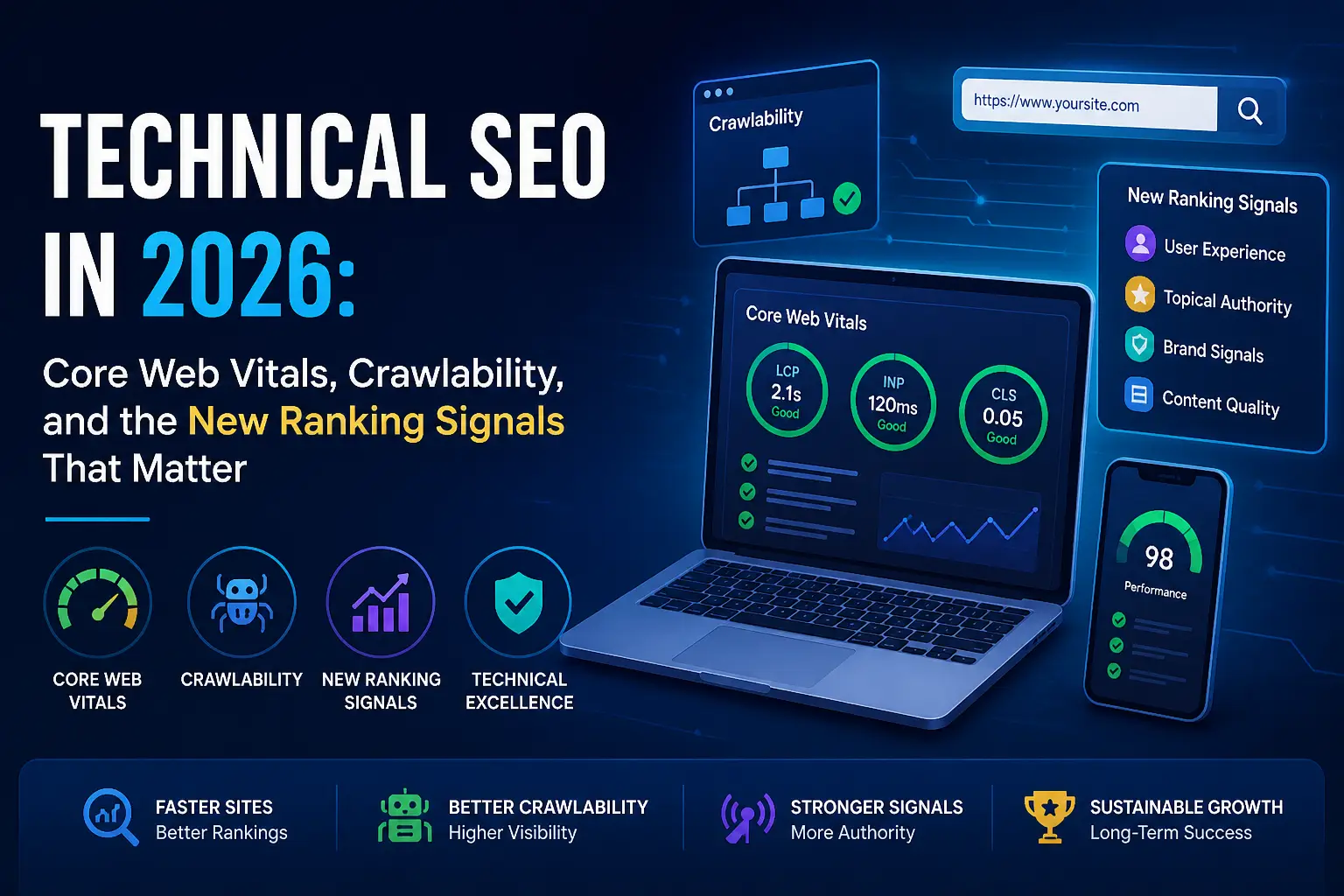
Google’s Core Web Vitals the page experience metrics that became a ranking factor in 2021 have evolved significantly. In 2026, the current Core Web Vitals set includes:
- Largest Contentful Paint (LCP): Measures loading performance how quickly the largest visible content element renders. Target: under 2.5 seconds.
- Interaction to Next Paint (INP): Replaced First Input Delay (FID) in March 2024. Measures the responsiveness of every user interaction throughout the entire page session, not just the first. Target: under 200ms.
- Cumulative Layout Shift (CLS): Measures visual stability how much the page layout shifts unexpectedly as it loads. Target: under 0.1.
INP is the most commonly failed Core Web Vital in 2026 because it requires optimizing JavaScript execution throughout the entire user session, not just on initial load. Heavy third-party scripts (analytics, ad platforms, chat widgets), unoptimized React/Vue components, and synchronous JavaScript execution are the primary INP failure causes.
If your website fails Core Web Vitals, you are conceding a direct ranking advantage to competitors who pass. Our WordPress SEO services team specializes in Core Web Vitals optimization for WordPress-based sites the most common platform where LCP and INP failures occur.
Crawlability and Indexation: The Prerequisites for Every Ranking
A fundamental truth in technical SEO: Google cannot rank a page it cannot crawl and index. While this sounds obvious, crawlability and indexation failures are among the most common and most damaging technical SEO issues affecting mid-market websites.
Crawl Budget Optimization
Google allocates a finite crawl budget to every website, a limit on how many pages Googlebot will crawl within a given timeframe. Large websites that waste crawl budgets on low-value pages (session ID URLs, filter combinations, internal search pages) see important pages go under-crawled and under-indexed.
In 2026, crawl budget management requires: blocking low-value URL patterns in robots.txt, consolidating duplicate content with canonical tags, reducing URL parameter proliferation, and ensuring your sitemap accurately reflects your highest-priority pages.
JavaScript Rendering and Indexation
Websites built with JavaScript frameworks (React, Vue, Angular, Next.js) present unique crawlability challenges. Googlebot must render JavaScript before it can extract content and JavaScript rendering is expensive and slow at Google scale. Pages that delay content rendering until after JavaScript execution risk reduced crawl frequency and delayed indexation.
The 2026 best practice: implement server-side rendering (SSR) or static site generation (SSG) for all SEO-critical content. Don’t hide primary content behind JavaScript execution requirements. Verify Google’s rendered view of your pages using the URL Inspection tool in Search Console.
Site Architecture and Internal Linking for Technical SEO
Site architecture, how pages are connected, how deep they sit from the homepage, and how PageRank flows through the site has an enormous impact on crawl efficiency, indexation depth, and ranking distribution.
Depth and Click Distance
Pages more than 3-4 clicks from the homepage are crawled less frequently and accumulate less internal PageRank. For large websites, ensuring that priority pages (product pages, service pages, key blog content) are accessible within 3 clicks from the homepage is a critical technical SEO requirement.
Internal Link Architecture
Strategic internal linking connecting relevant pages with descriptive anchor text distributes PageRank to priority pages and helps Google understand topical relationships across your site. In 2026, AI-powered search systems also use internal link signals to understand entity relationships and topical authority.
Our SEO services agency conducts complete site architecture audits as part of every engagement mapping crawl paths, identifying orphaned pages, and building internal link strategies that distribute authority to the pages that matter most for your revenue.
Mobile-First Indexing: No Longer Optional
Google has operated on mobile-first indexing since 2019 meaning it uses the mobile version of your site for ranking decisions. In 2026, this is so foundational it barely warrants debate. But a surprising number of mid-market websites still deliver a meaningfully degraded mobile experience.
Key mobile-first technical requirements in 2026: responsive design (not separate mobile URLs), equivalent content on mobile and desktop versions, tap target sizing meeting minimum 44x44px recommendations, font sizes legible without zooming (minimum 16px), and no interstitials that obstruct content on mobile (penalized since 2017).
HTTPS, Security, and Trust Signals
HTTPS has been a Google ranking signal since 2014. In 2026, it’s baseline virtually every competitive site runs HTTPS. But security-related technical SEO has expanded beyond HTTPS:
- Mixed content warnings: HTTPS pages loading HTTP resources trigger browser warnings and reduce user trust signals
- Security headers: Content Security Policy (CSP), HSTS, X-Frame-Options headers contribute to crawl trustworthiness
- Site hacking and malware: Google’s Safe Browsing program can delist compromised sites rapidly monitoring and security maintenance is essential
- Uptime and reliability: Frequent 5xx server errors signal unreliability and can depress crawl frequency and rankings
Structured Data and Schema Markup in 2026
Structured data JSON-LD schema markup that provides machine-readable context about your content has become more important as AI-powered search features multiply. Rich results (FAQ rich snippets, How-To, Product, Review, Local Business, Article) all require correct schema implementation.
In 2026, structured data also feeds directly into AI Overview citations and entity recognition. Marking up your organization’s knowledge panel data (name, address, sameAs properties linking to authoritative profiles) helps Google’s AI correctly attribute and cite your content.
Comprehensive structured data implementation is part of every Techlooker SEO consulting services engagement. We audit existing schema, identify rich result opportunities, and implement correct JSON-LD markup across all priority page templates.
Technical SEO Audit: Where to Start
If you’re not sure where your technical SEO stands in 2026, a structured audit is the first step. The priority areas to audit:
- Core Web Vitals scores (PageSpeed Insights and Chrome User Experience Report)
- Crawl budget usage and blocked/non-indexed page inventory
- JavaScript rendering verification via Search Console URL Inspection
- Internal link depth mapping and orphaned page identification
- Mobile usability issues (Search Console Mobile Usability report)
- Structured data validation (Google’s Rich Results Test)
- Duplicate content and canonical tag implementation
A complete technical SEO audit typically reveals 10-30 prioritized issues each with a clear business impact estimate and implementation recommendation. Contact Techlooker’s technical SEO team to schedule your free initial audit.
1. What is technical SEO in 2026?
Technical SEO in 2026 focuses on optimizing website performance, crawlability, and user experience to align with search engine algorithms and AI-driven ranking systems.
2. What are Core Web Vitals in 2026?
Core Web Vitals measure user experience based on loading speed, interactivity, and visual stability. Key metrics include LCP, INP, and CLS.
3. Why is crawlability important for SEO?
Crawlability ensures search engines can access, understand, and index your website content efficiently, which directly impacts rankings.
4. What are the new ranking signals in 2026?
New ranking signals include user experience, content quality, topical authority, AI relevance, and engagement metrics.
5. How can I improve Core Web Vitals?
You can improve Core Web Vitals by optimizing images, reducing JavaScript, improving server response time, and using a CDN.
6. Does technical SEO still matter with AI search?
Yes, technical SEO is more important than ever because AI search systems rely on structured, fast, and accessible websites to generate accurate summaries.