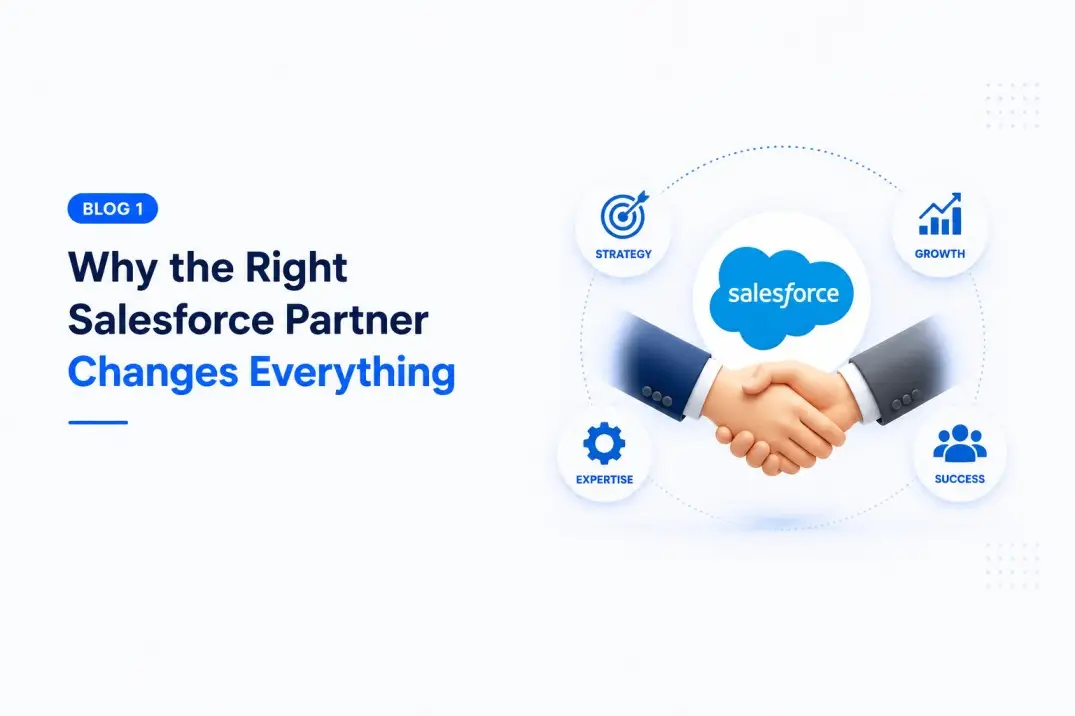
Why Does Your Choice of Salesforce Partner Actually Matter?
Most businesses treat Salesforce as software. The real winners treat it as strategy.
Salesforce is the most powerful CRM platform in the world. But power without precision delivers nothing.
A wrong implementation wastes six to twelve months. It costs hundreds of thousands in lost productivity.
The right Salesforce development company makes the difference between a CRM that frustrates your team and one that drives measurable, compounding revenue growth.
This is not a technology decision. It is a business decision.
What Is a Salesforce Development Company?
A Salesforce development company does far more than install software.
It designs, builds, and optimises every layer of your Salesforce environment:
- CRM implementation and configuration for your specific business workflows
- Custom Apex code, Lightning Web Components, and Visualforce for unique requirements
- API integrations connecting Salesforce to your ERP, marketing tools, and data systems
- Einstein AI and Agentforce automation to reduce manual work across sales and service
- AppExchange app development for companies building products on the Salesforce platform
- DevOps pipelines for safe, fast, and repeatable Salesforce deployments
- Managed services for ongoing administration, monitoring, and user support
At TechLooker, these are not separate offerings. They are a connected delivery model built around your business outcomes.
What Are the Facts? Salesforce by the Numbers in 2026
- Salesforce holds 23% of the global CRM market, more than the next four competitors combined (IDC 2026)
- The Salesforce economy is projected to generate $1.8 trillion in global GDP impact by 2028 (IDC)
- Companies that implement Salesforce with a certified partner see 35% faster time-to-value than self-implementations
- Businesses using Einstein AI inside Salesforce report a 28% increase in lead conversion rates
- 96% of Fortune 500 companies use Salesforce in some capacity
- Poor CRM implementations cost US businesses over $30 billion annually in lost productivity
The numbers confirm what every operations leader intuitively knows.
Salesforce done right is transformational. Salesforce done wrong is expensive.
Related TechLooker Services
Salesforce Development | Salesforce Data Migration | RedTail to Salesforce Migration | Data Visualization Services | Power BI Consulting | AI SEO Services
How Is the Industry Doing? Salesforce Market Trends in 2026
AI Is Now the Core of Every Salesforce Conversation
Einstein AI and Agentforce have changed what CRM means entirely.
Businesses are no longer just storing customer data. They are using AI to act on it autonomously.
Agentforce agents now handle sales outreach, service ticket resolution, and marketing qualification without human intervention.
Companies deploying Agentforce agents in 2026 are compressing their sales cycles by 30 to 40%.
The Shift from Implementation to Continuous Optimisation
The old model was: implement, train, go live, done.
The new model is: implement, iterate, automate, scale.
Businesses that treat Salesforce as a living system see compounding returns year after year.
This is why managed services and DevOps have become central to every serious Salesforce engagement.
Data Cloud Is Reshaping the CRM Landscape
Salesforce Data Cloud unifies data from every source into a single customer profile in real time.
This means marketing, sales, and service teams all see the same live picture of every customer.
Data Cloud adoption doubled in 2025. It is set to double again in 2026.
Organisations without a Data Cloud strategy are building on an incomplete foundation.
The Talent Gap Is Growing
Demand for certified Salesforce professionals outpaces supply by a ratio of 4:1 globally.
Hiring an in-house Salesforce architect costs $180,000 or more annually in the US market.
Staff augmentation from a specialist Salesforce partner delivers equivalent expertise at significantly lower cost.
What Could Be Better? The Biggest Salesforce Implementation Mistakes
Going Live Without a Change Management Plan
Salesforce fails when people do not use it.
Technology without adoption is wasted investment.
Change management, user training, and executive sponsorship determine adoption rates more than any technical decision.
Over-Customising Out of the Box Functionality
Salesforce ships with hundreds of powerful native features.
Many businesses immediately customise everything before understanding what already exists.
Excessive customisation creates technical debt that makes every future upgrade painful and expensive.
Skipping the Data Audit Before Migration
Bad data migrated into Salesforce is still bad data.
Migrating without cleaning, deduplicating, and normalising your existing data creates problems that compound for years.
A thorough pre-migration data audit is not optional. It is the foundation of a successful implementation.
TechLooker’s Salesforce data migration service includes a full data audit, cleanse, transformation, and validation process.
Choosing a Generalist Agency Over a Certified Partner
Salesforce certifications matter.
There are over 40 distinct Salesforce certifications covering administration, development, architecture, and consulting.
A generalist IT agency with one or two certified staff cannot deliver what a Summit-level partner with 200+ certified professionals can.
How TechLooker Can Help: Salesforce Development Built for Results
TechLooker is a Salesforce Summit (Platinum) Partner. Our custom Salesforce development services serve businesses from early-stage startups to Fortune 500 enterprises.
Here is what sets our delivery apart:
200+ Certified Professionals on Every Project
You never get a junior team on a senior contract. Every TechLooker project is staffed with pre-vetted, multi-certified Salesforce professionals matched to your specific requirements.
500+ Projects Delivered Globally
Our project library spans manufacturing, financial services, healthcare, retail, SaaS, nonprofits, and government.
We have solved every common implementation challenge, and most of the uncommon ones.
Einstein AI and Agentforce Expertise
We are Einstein AI Certified and Agentforce Certified.
Our AI automation practice deploys intelligent agents that work inside your Salesforce org 24/7.
Real business outcomes include 40% reduction in service handling time and 28% improvement in pipeline conversion.
Full-Spectrum Service from Day One to Scale
From initial consulting and architecture design to Salesforce data migration, DevOps, managed services, and AppExchange publishing, TechLooker handles every phase under one roof.
HIPAA, GDPR, and Enterprise Security Compliance
Every implementation TechLooker delivers is built to enterprise security standards from the start.
No retrofitting security after the fact. Compliance is engineered in from day one.
Frequently Asked Questions about Salesforce Development Companies
Q1: What does a Salesforce development company actually do?
A Salesforce development company plans, builds, and optimises your Salesforce environment. This includes CRM implementation, custom code development in Apex and Lightning Web Components, third-party system integrations, AI automation, and ongoing managed support. A qualified partner does not just configure what already exists. It builds what your specific business requires.
Q2: How do I choose the right Salesforce development partner?
Look for a certified partner tier of Gold, Platinum, or Summit. Verify the number and range of certifications across administration, development, and architecture. Review their industry experience and ask for case studies in your sector. Assess their AI and automation capability, not just their classic CRM delivery. A Summit partner with 200-plus certified professionals like TechLooker represents the highest tier of Salesforce expertise.
Q3: How long does a Salesforce implementation take?
A standard Sales Cloud or Service Cloud implementation for a mid-market business takes eight to sixteen weeks from discovery to go-live. Complex multi-cloud implementations, Einstein AI deployments, or enterprise environments with extensive ERP integrations can take four to nine months. TechLooker provides a detailed project timeline during the discovery phase so expectations are set clearly from the start.
Q4: What is the difference between Salesforce implementation and Salesforce development?
Salesforce implementation refers to configuring and deploying the standard Salesforce platform for your business. This includes setting up objects, workflows, profiles, and standard features. Salesforce development goes beyond configuration to include custom code, custom objects, Lightning components, custom integrations, and AppExchange app development. Most enterprise projects require both.
Q5: Can TechLooker work with our existing Salesforce org?
Yes. TechLooker performs full org audits before beginning any work on an existing Salesforce environment. This covers security settings, technical debt, outdated automations, unused customisations, and data quality. The audit produces a prioritised action plan that addresses immediate risks and long-term optimisation opportunities.
Q6: What is a Salesforce Summit Partner?
Summit is the highest tier in the Salesforce partner ecosystem, previously known as Platinum. Summit partners are held to the strictest performance, certification, and customer success standards. They have access to Salesforce product roadmaps, dedicated partner support, and priority resources. Choosing a Summit partner like TechLooker means you work with a team held to the highest standards Salesforce recognises.
Q7: How much does custom Salesforce development cost?
Costs vary significantly based on scope, complexity, and timeline. A focused Sales Cloud implementation for a small team may start at $20,000 to $40,000. An enterprise multi-cloud implementation with custom integrations, AI automation, and a DevOps pipeline can range from $150,000 to $500,000 or more. TechLooker provides transparent scoped pricing after a discovery engagement, so there are no surprises.
Q8: Does TechLooker offer Salesforce staff augmentation?
Yes. TechLooker can extend your internal Salesforce team within 48 hours. We match certified developers, architects, administrators, and consultants to your project on a flexible Time and Material basis. There is no long-term commitment, no recruitment overhead, and no risk. Teams scale up or down based on your project phase.
Q9: What industries does TechLooker serve with Salesforce?
TechLooker has delivered Salesforce projects across financial services, healthcare, manufacturing, retail, SaaS, nonprofits, education, government, and professional services. We hold expertise in industry-specific Salesforce clouds including Financial Services Cloud, Health Cloud, Manufacturing Cloud, Nonprofit Cloud, and Education Cloud.
Q10: What is Agentforce and why does it matter?
Agentforce is Salesforce’s autonomous AI agent platform. It allows businesses to deploy intelligent agents that independently handle tasks like sales outreach, customer service responses, lead qualification, and workflow approvals without human intervention. Agentforce agents work around the clock inside your Salesforce org. TechLooker is one of a small number of partners globally that holds full Agentforce certification.
Q11: How does TechLooker ensure data security during implementation?
TechLooker follows enterprise security standards on every project. This includes role-based access controls, field-level security configuration, two-factor authentication enforcement, encrypted data handling, and audit trail activation. All implementations are built HIPAA and GDPR compliant by default where applicable. Security is not added after deployment. It is designed into the architecture from day one.
Q12: Can Salesforce integrate with our existing ERP system?
Yes. TechLooker has integrated Salesforce with SAP S/4HANA, Oracle ERP, Microsoft Dynamics, NetSuite, QuickBooks, Sage, and dozens of other enterprise systems. Integration methods include REST and SOAP APIs, MuleSoft Anypoint Platform, Jitterbit, Boomi, and custom middleware. Bi-directional, real-time data synchronisation eliminates manual data entry and ensures your teams always work from a single source of truth.