
Enterprise SEO · USA & Canada
Enterprise SEO Services for Sites Too Big to Fix Page by Page
Our enterprise SEO services are for websites with thousands of URLs, several teams and a formal release process. We work at the level of templates, crawl budget and internal linking instead of single pages, write fixes as developer tickets your team can ship, and report to stakeholders in the terms they already use.
✓ Template-level fixes, not page-level patches
✓ Tickets written for your developers
✓ Works alongside your in-house team

Your monthly report
Indexed pages, template health and organic revenue by site section, ready to share with leadership.
Search Console · crawl data · GA4
Where large sites need to perform
Enterprise SEO, explained
What Do Enterprise SEO Services Cover?
Enterprise SEO services handle search for large websites, where one change to a template can affect thousands of URLs at once. The work covers crawl budget and indexation, template and internal linking fixes, international and multi-brand setups, migrations, and the process that gets SEO requirements into development work before release instead of after.
On a small site you can fix a title tag by hand. On a site with fifty thousand product, location or article pages, the same problem has to be solved once in the template, tested on staging and shipped through your release cycle. That is the difference between enterprise SEO and regular SEO: less manual editing, more systems, data and coordination between teams.
What's included
Crawl and log analysis, indexation control, template SEO, internal linking, international SEO, migrations, governance and stakeholder reporting.
Who it's for
Large ecommerce catalogs, publishers, marketplaces, multi-location and multi-brand companies, and SaaS sites with big docs or template libraries.
How long it takes
An audit and backlog in the first month. Results then depend on how quickly fixes ship through your release cycle, usually measured in quarters.
How we work with your team
Inside your tools: your ticket system, your staging site, your analytics. We support your SEO and engineering staff rather than replace them.
Why large sites stall
Why SEO Stalls on Large Websites
Big sites rarely fail because of one missing keyword. They stall because of scale problems that small-site tactics can't fix. These are the three we look for first.
Googlebot spends time on the wrong URLs
Faceted filters, sort parameters, session IDs and endless calendar pages can create far more URLs than you have real pages. Crawlers waste time there while new and updated pages wait.
Fixes sit in the backlog for months
An SEO recommendation without a clear ticket, an estimate and a business case loses to every feature request. Good findings that never ship change nothing.
Every team owns a piece and nobody owns search
Content, product, engineering and regional teams each change the site. Without shared rules, one release can undo another team's SEO work without anyone noticing.
What's included
Enterprise SEO Agency Services Built Around Templates
We start with an audit and agree a fixed monthly scope. These are the areas we cover, combined based on where your site loses the most.
Crawl budget and log analysis
Server logs and crawl data show where search engine bots actually spend their time, which sections they ignore and which URLs waste their visits.
Technical SEO guide →Indexation control
Canonicals, noindex rules, parameter handling and faceted navigation, set so the pages you want indexed get indexed and the rest stay out.
Faceted navigation in our ecommerce guide →Template optimization
Titles, headings, structured data, internal links and page speed fixed once per template, so every page built on it improves together.
Site speed work →Internal linking at scale
Navigation, breadcrumbs, related-item modules and hub pages designed so authority reaches deep pages, not only the homepage and top categories.
Our core SEO services →International and multi-brand SEO
Hreflang, country and language folders, duplicate content across brands, and French-language pages for Quebec built to rank on their own.
International SEO checklist →Migrations and replatforming
URL mapping, redirect testing on staging, launch-day checks and post-launch monitoring for platform, domain and structure changes.
Migration checklist →Governance and developer tickets
SEO requirements for new templates, pre-release checklists and tickets with acceptance criteria your engineers can estimate and test.
SEO consulting →Stakeholder reporting
Dashboards in Power BI or Looker Studio that show organic performance by section, market and brand, with revenue from GA4 where you track it.
Power BI consulting →AI search on large sites
Crawler access for AI search bots, consistent entity data across brands, and answer-first content on the pages AI tools are most likely to cite.
AI SEO services →
Find Out Where Googlebot Spends Its Time
Our free enterprise SEO audit reviews a crawl sample and your Search Console data, and if you can share server logs, shows which sections search engines visit and which they skip.

How we prioritize
Templates First, Then Sections, Then Pages
A large-site audit can produce thousands of rows. We group issues by the template or rule that causes them, estimate how many URLs and how much traffic each one touches, and weigh that against engineering effort. Your developers get a short list, not a spreadsheet dump.
Templates that serve the most URLs
One fix to a product or location template can improve thousands of pages at once.
Crawl waste and index bloat
Removing junk URLs from the crawl helps search engines find the pages that earn money.
Sections that drive revenue
We look at which categories, markets or brands matter most to the business before we touch the rest.
Fixes your team can ship this sprint
Small, well-scoped tickets go into the next release while bigger changes are planned properly.
How it works
The First 90 Days of an Enterprise SEO Engagement
Large sites move on release cycles, so we plan around yours. Each month you know what is in the backlog, what shipped and what it changed.
Access, stakeholders and baseline
We get access to analytics, Search Console and your ticket system, meet the teams that touch the site, and record a performance baseline.
Crawl, logs and template audit
We crawl the site in sections, review logs if available, and trace each issue back to the template or rule that causes it.
Tickets into your sprints
The top fixes become tickets with acceptance criteria. We answer engineering questions and test changes on staging.
Governance and a leadership report
We agree pre-release SEO checks with your teams and deliver the first report on what shipped and what moved.

Planning a Migration or Replatform?
Bring SEO in before the URL map is final. Our checklist covers the redirect, staging and launch-day steps that protect rankings on a large site.
Choosing a model
In-House Team, Enterprise SEO Agency, or Both?
Most large organizations end up with a mix. The right split depends on how much SEO knowledge you already have in-house and how much engineering time you can get. Here is how the three models compare.
In-house
In-house SEO team
Best at
Knowing the business, the politics and the release calendar.
Watch out for
Small teams stretched across audits, content and reporting with little time for deep technical work.
Works when
You can hire specialists for technical, content and analytics roles and keep them.
Agency
Enterprise SEO agency
Best at
Specialist skills on demand and an outside view of problems your team has stopped seeing.
Watch out for
Recommendations that never ship because nobody inside owns them.
Works when
Someone in-house has authority to prioritize the work with engineering.
Hybrid
In-house lead plus agency
Best at
Combining internal ownership with outside depth in logs, migrations or international SEO.
Watch out for
Unclear roles. Write down who decides, who writes tickets and who reports.
Works when
The agency works inside your tools and process, not in a parallel one.
How We Turn SEO Findings Into Tickets Developers Ship
An audit only matters if the fixes go live. Our SEO specialists work next to developers who build websites every day, so we write tickets the way engineers expect them. Google's own guide to managing crawl budget on large sites is a good primer for your team on why some of this work matters.
01
Group issues by cause
Thousands of affected URLs usually trace back to a handful of templates, rules or modules. We report the cause, not every symptom.
02
Size the impact
We estimate URLs, traffic and revenue touched by each fix using your own analytics and Search Console data.
03
Write the ticket properly
Each ticket states the problem, example URLs, the expected change and acceptance criteria a QA tester can check.
04
Test on staging
We crawl staging before release to confirm the fix works and nothing else broke, such as canonicals or robots rules.
05
Verify after release
We check the live site, request recrawls where useful and watch Search Console for the expected change.
06
Prevent regressions
Pre-release checks and alerts catch the same problem if a later release brings it back.
Why Techlooker
Why In-House Teams Bring In Techlooker for Enterprise SEO
We are a focused team, not a giant network. Here is what we bring to a large site, and what you should hold us to.
SEO and developers on one team
Our tickets are reviewed by people who build websites, so they are realistic, estimable and clear about what done means.
We work in your tools
Your ticket system, your staging site, your analytics and Search Console. Everything stays in your accounts and you own all of it.
Reporting leadership can read
We combine Search Console, GA4 and call tracking where relevant, and can build dashboards in Power BI for teams that already report there.
Data and CRM skills in-house
The same team handles Salesforce and data projects, which helps when organic leads need to be traced into a CRM.
English and French for Canada
We can plan and produce French-language pages for Quebec and set up hreflang across US and Canadian versions.
Honest about scope
We will tell you which parts we should own and which your own team will do better, and we will not promise outcomes we cannot control.
Ways to work with us
Engagement Models for Enterprise SEO
Large organizations buy SEO help in different ways. Choose the model that fits your team, budget cycle and release process.
Embedded enterprise SEO support
A fixed monthly scope covering audits, tickets, QA, governance and reporting, working inside your sprint cadence.
Best for: teams with a backlog and no time to clear it
Technical and template audit
A crawl, log and template review turned into a prioritized ticket list with impact estimates.
Best for: in-house SEO teams who need a second opinion
Migration and replatform support
URL mapping, redirect QA, launch checks and post-launch monitoring for a defined project.
Best for: teams changing platform, domain or structure
SEO governance consulting
Standards, pre-release checklists, training and regular reviews for teams that do the work themselves.
Best for: organizations with many teams editing one site
Before you hire anyone
What Good Enterprise SEO Looks Like, and the Warning Signs
What you should expect
✓ Findings grouped by template and cause
✓ Tickets your engineers can estimate and test
✓ Impact sized with your own data
✓ Reporting by section, market and brand
✓ Clear roles between your team and the agency
Warning signs
✕ A 400-page audit with no priorities
✕ Guaranteed rankings or traffic numbers
✕ Advice that ignores your release process
✕ Mass-produced pages to chase keywords
✕ Tools and data held in the agency's accounts
Google's guide Do you need an SEO? is worth sharing with your procurement team before you sign with any vendor.
Related services
Related Services for Large and Complex Websites

Running Sites in English and French?
Our international SEO checklist covers hreflang, URL structure and French-language content for companies serving both the USA and Canada.
FAQ
Questions About Enterprise SEO Services
Answers to what SEO leads, marketing directors and engineering managers ask before bringing in an enterprise SEO company. Don't see yours? Ask and a specialist will reply.
Ask an Enterprise SEO Specialist
How much do enterprise SEO services cost?
It depends on the size and complexity of the site, the number of markets and brands, and how much of the work your own team covers. A focused technical audit costs far less than an ongoing embedded engagement. We quote a fixed monthly or project scope after a free audit, so the cost is clear before you commit.
What makes enterprise SEO different from regular SEO?
Scale and process. Problems are solved in templates and rules rather than page by page, crawl budget and indexation matter more, and every change goes through developers, QA and a release calendar. A lot of the work is coordination: writing clear tickets, setting standards and reporting to several stakeholders.
How big does a site need to be to need enterprise SEO?
There is no fixed number. Signs you need it include tens of thousands of URLs, faceted navigation or user-generated pages, several brands or countries, many teams publishing to one site, or SEO fixes that keep stalling in the development backlog.
How long before enterprise SEO shows results?
The audit and backlog come in the first month. After that, results depend mostly on how fast fixes ship. A template fix that goes live in the next sprint can show up in Search Console within weeks; changes that wait two quarters for engineering time take two quarters longer.
What is crawl budget, and does it matter for my site?
Crawl budget is roughly how many URLs a search engine is willing and able to crawl on your site in a given period. Google says it mainly matters for very large or frequently changing sites; see its guide to managing crawl budget. If new pages take a long time to get indexed, it is worth checking.
Do you replace our in-house SEO team?
No. Most large organizations should keep someone in-house who owns SEO and knows the business. We add specialist depth in technical audits, logs, migrations, international setups and reporting, and extra hands when the backlog is long.
Can you work with our developers and release process?
Yes. We write tickets in your system with acceptance criteria, join planning calls when useful, review changes on staging and verify them after release. Our own developers review the tickets first so they are realistic.
Do you handle international and multi-brand sites?
Yes. We set up hreflang, choose between folders, subdomains and separate domains, handle duplicate content across brands, and can produce French-language pages for Quebec. Our international SEO checklist covers the basics for the USA and Canada.
Which platforms do you work with?
Most of our development work is on WordPress and WooCommerce, but the SEO side applies to any platform, including custom builds and headless setups. For platforms we don't develop on, we write tickets for your engineers instead of making changes ourselves.
How do you report to leadership?
With a monthly summary of what shipped, what moved and what is next, plus dashboards that break organic performance down by section, market or brand. We can build them in Power BI or Looker Studio, pulling from Search Console and GA4.
Who owns the accounts, data and tools?
You do. We work in your analytics, Search Console, ticket system and crawl tool accounts wherever possible, and anything we build for you stays with you.
What do you need from us to get started?
Read access to Search Console and analytics, a contact on the engineering side, access to your ticket system and staging site, and server logs if you can share them. A short call about which sections and markets matter most helps us focus the audit.
Keep learning
Guides for Teams Running Large Websites

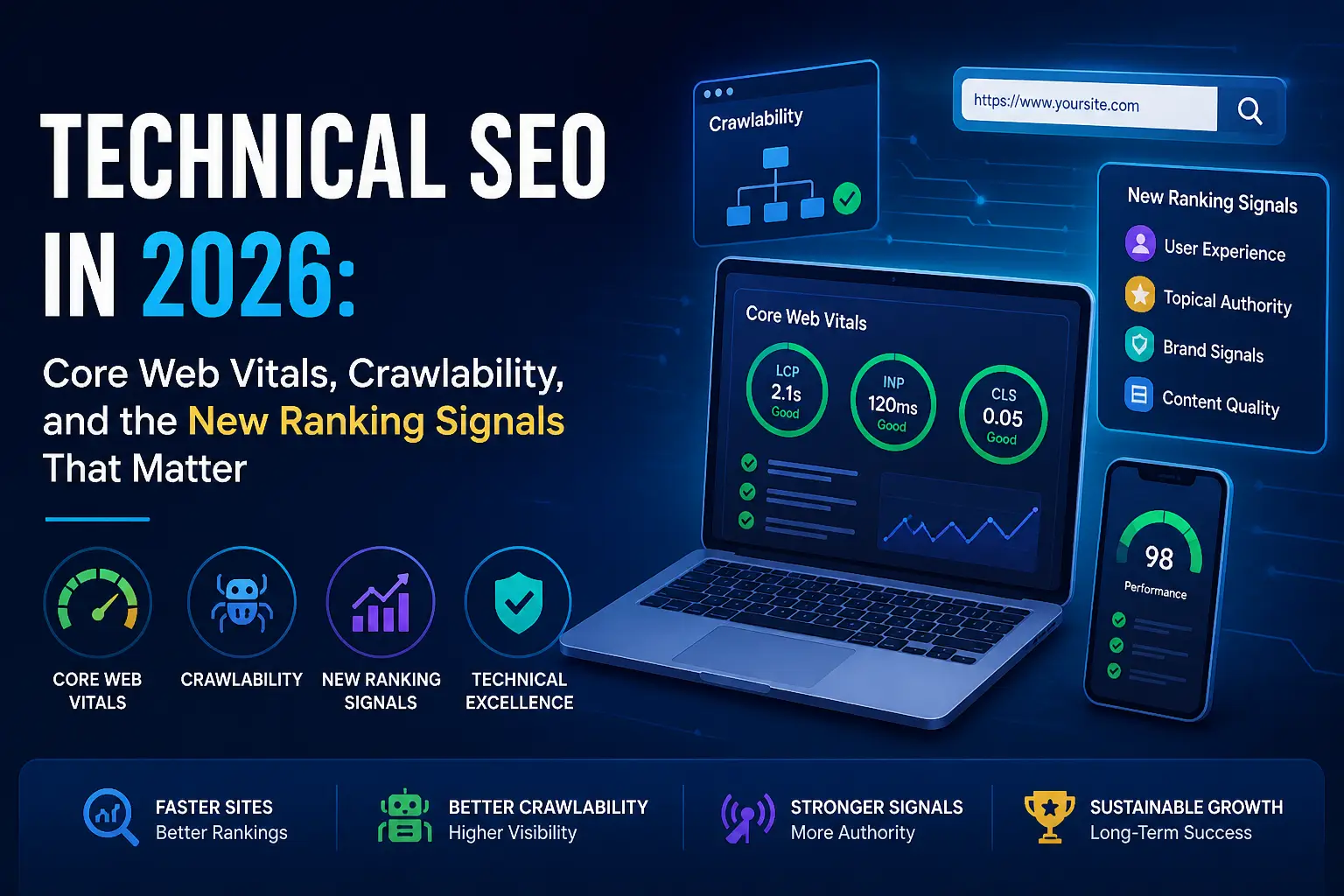
Technical SEO in 2026: Core Web Vitals, Crawlability, and the New Ranking Signals That Matter
Read the guide →